Wednesday, September 26, 2001
Page 9
Perspectives (Column)
Public Defender Alleges LAPD Spewed Phony Notices of Court Orders
By ROGER M. GRACE
An inter-agency governmental fray which somehow eluded public attention has come to an end. The Office of Los Angeles District Attorney, acting at the behest of the Los Angeles County public defender, conducted a criminal investigation of Los Angeles Police Department personnel, with the chief of police and the Office of Los Angeles City Attorney pooh-poohing the accusations.
The behind-the-scenes skirmishing started when Public Defender Michael Judge wrote to then-District Attorney Gil Garcetti on Oct. 16, 2000 complaining of “a corrupt pattern and practice by and on behalf of the Los Angeles Police Department.” He accused police personnel of “routinely handing over bogus notices of protective orders, falsely claiming that the court has severely restricted the use of critical evidence of police misconduct….”
What was perhaps the final volley was fired Sept. 12 by Mark G. Harvis, advisor to the Public Integrity Assurance Section of the Public Defender’s Office. Reacting to the decision of the District Attorney’s Office not to prosecute—made in light of the Police Department’s discontinuation of the complained-of practice—Harvis dispatched a heated missive to the DA’s Office in which he derided a statement by Police Chief Bernard Parks and bemoaned the “profoundly flawed ethical stance heretofore taken by the City Attorney’s office.”

Here’s how Judge views what was occurring:
A client would insist the arresting officer had engaged in misconduct (such as planting evidence or using excessive force). A deputy PD would make a Pitchess motion to discover previous allegations against that officer of similar misconduct. An LAPD custodian of records would come to court and meet with the judge in chambers. The judge would order that, in connection with certain complaints, information be turned over to the defense as to the identity and whereabouts of complainants, as well as witnesses. The deputy public defender would be supplied with a compliance sheet; it would contain the required information, along with either the long-version or short-version notice of a protective order:
•“Pursuant to Evidence Code Section 1045, subdivisions (d) and (e), a PROTECT ORDER has been issued by [¶] Judge [name], Div/Dept [number], on [date]”; or
•PROTECT ORDER has been issued by [¶] Judge [name], Div/Dept [number], on [date] prohibiting all disclosure of information provided below and on the attached pages (if any), except as follows: Use of this information by the prosecutor or defense counsel is limited to the present case only; and disclosure is NOT permitted of names, addresses, telephone numbers or other information provided below or in the attached, to the defendant, or any other person, or in any other matter. Unauthorized disclosure may be prosecuted under California law as either a misdemeanor or a felony.”
|
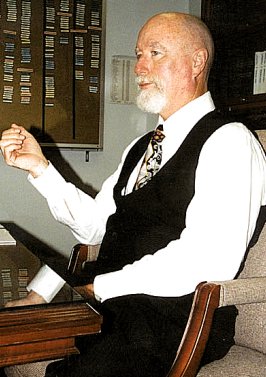
MICHAEL JUDGE Los Angeles County Public Defender Seated in the Conference Room on the 19th Floor of the Criminal Courts Building, Judge complains of “a corrupt pattern and practice by and on behalf of the Los Angeles Police Department.”
|
|
In case after case, the recitals in those forms turned out to be false, Judge asserts. Orders of such breadth had not been made, he says, alleging that the custodians committed misdemeanors under Penal Code §166(a)(a) (publishing “a false or grossly inaccurate report of the proceedings of any court”), as well as contempts of court.
Harvis recounts that one day, “probably in the summer or fall of 2000,” an allusion was made in court to a protective order the judge had issued. He relates: “The judge said, ‘No, I didn’t issue a protective order.’”
An investigation uncovered 31 “bogus orders” in “about 10 cases,” the deputy declares.
Among the documents he provided to me was a compliance sheet in People v. Towne, BA 201455. It recites that a protective order (denominated, ungrammatically, a “protect order”), had been issued by Los Angeles Superior Court Judge Marsha Revel under both subdivisions (d) and (e) of Evidence Code §1045. However, the minute order shows: “A PROTECTIVE ORDER PURSUANT TO SECTION 1045(E) EVIDENCE CODE REGARDING [the information ordered to be disclosed] IS ISSUED BY THE COURT.”
The difference between an order issued under those two subdivisions is, to Judge’s way of thinking, critical.
“A subdivision (e) order is supposed to be issued in every case,” he says, adding that the subsection limits use of the information to litigation purposes.
“That’s the only limit,” the public defender insists. “We can’t disseminate the information to the public.”
But, as he interprets the section, it does permit use of the information in other cases involving the same officer.
“A subdivision (d) order is something else entirely,” he continues. Under that subdivision, he says, “the court can very severely restrict the use of information.” When an order is made under that provision, Judge explains, it means the information “can only be used in this specific case.”
This results in the same personnel files being sought anew in other cases, Judge says. It necessitates complainants and witnesses being interviewed by investigators repetitively, resulting in them feeling harassed by the Public Defender’s Office and rendered uncooperative, he complains. (Judge tells of supervisors being bewildered by directives to send investigators out to interview persons who had just been questioned.)
The significance of this burden is seemingly heightened in light of the recent upsurge in the use of Pitchess motions, authorized in Pitchess v. Superior Court (1974) 11 Cal.3d 531. “As Rampart unfolded,” Head Deputy Public Defender Kelly G. Emling tells me, “the number of Pitchess motions increased,” with defendants’ assertions of police misconduct becoming more believable.
If you take a look at subdivisions (d) and (e) of §1045, they do not appear to be as Judge characterizes them:
“(d) Upon motion seasonably made by the governmental agency which has custody or control of the records to be examined or by the officer whose records are sought, and upon good cause showing the necessity thereof, the court may make any order which justice requires to protect the officer or agency from unnecessary annoyance, embarrassment or oppression.
“(e) The court shall, in any case or proceeding permitting the disclosure or discovery of any peace officer records requested pursuant to Section 1043, order that the records disclosed or discovered may not be used for any purpose other than a court proceeding pursuant to applicable law.”
Subdivision (d) does not, on its face, preclude use of the information in other cases, and subd. (e) does not spell out whether the information may be used in subsequent cases or not.
Judge explains that judges were “routinely issuing orders” that restricted use of information disclosed pursuant to a Pitchess motion to the case before the court, and doing so notwithstanding the requirement of subd. (d) that a noticed hearing take place. When his deputies received notice that a protective order had been issued under subd. (d), he says, “it was just assumed that it was the normal order,” adding:
“It was just assumed that no client was going to stand still while we litigated this in the Court of Appeal or the Supreme Court.”
In contrast to Judge’s view that an order under subd. (e) does not bar use of the information in other proceedings is the notion of the Fourth District’s Div. One that it does. It said so in an opinion filed last May in Alford v. Superior Court.
On Aug. 8, however, the Supreme Court granted review in Alford. The Office of Los Angeles Public Defender had filed an amicus curiae letter brief in that case, drafted by Harvis, arguing that the legislative history of subd. (e) precluded the interpretation of the provision lent it by the San Diego appeals court.
In any event, the District Attorney’s Office declined to prosecute. James L. Cosper, acting head deputy of the Bureau of Fraud and Corruption Prosecutions’ Justice Integrity Division, said in an Aug. 13 letter to Harvis that the matter appears to have been resolved. He attached a copy of an Aug. 1, 2001, letter to an investigator for the District Attorney’s Office from Deputy City Attorney Kim Rodgers Westhoff, who supervises her office’s Police Discovery Section, reporting that “[t]he compliance sheets are of a form which is no longer in use by LAPD and LAPD has been asked to destroy any copies which it may find to avoid the possibility of use.”
Cosper commented:
“It appears that the police department has taken steps to ensure that this problem does not occur again. From information we have reviewed, we are satisfied with their efforts.”
Harvis was not satisfied. Tomorrow, I’ll quote from his letter in response to Cosper’s and tell how the City Attorney’s Office views the brouhaha.
* * *
CASE SETTLED—Last week, I wrote about a case in which the appropriate divvying of attorney fees among three lawyers who had represented actress Julie Newmar was being litigated. The case, St. Clair v. Ambrosio, was scheduled to go to trial yesterday in Los Angeles Superior Court. It was settled at the last minute.
Plaintiff Grace Greer St. Clair claimed that she was induced to assist neophyte lawyer Claire Ambrosio in representing Newmar by virtue of Ambrosio’s oral pledge to split fees evenly with her if the case—taken on a 30 percent contingency basis—spawned a recovery. The case wound up being settled for $150,000, with St. Clair not participating in the settling of the case, being otherwise occupied (delivering a baby). Joining Ambrosio in representing Newmar at the settlement conference was Judy Cannavo. Her role in the case, the plaintiff asserts, was minimal and, under an oral agreement, her fees were to be capped at $5,000. According to St. Clair’s math, 30 percent of $150,000 is $45,000, and according to her understanding of the fee arrangement, Cannovo should have received $5,000, with Ambrosio and her splitting the remaining $40,000 evenly. Instead, she was paid $8,000. She sued Ambrosio and Cannovo for the $12,000 she claimed was due (plus additional sums under tort theories).
Ambrosio’s position, as set forth in her trial brief drafted by Beverly Hills attorney Thomas M. Byrne, was this: “As Plaintiff was not involved in the final resolution of the matter because she in essence had abandoned the client, she is only entitled to her fee under a quantum meruit theory. This is only because another attorney—Cannavo—had to come in and bring the resolution home. [¶] Without Cannavo, or someone else like her, the matter doesn’t bring near $150,000. [¶] That expertise costs.”
The resolution, announced yesterday in the Redondo Beach courtroom of Los Angeles Superior Court Judge Ramona See, resulted in an even three-way split of the fees. Taking into account that Cannovo and Ambrosio had agreed with Newmar to lower the fees by $2,500, the settlement was that each of the three lawyers would receive one-third of $42,500, or $14,167. St. Clair’s Superior Court action brought her an additional $6,166.67.
The inevitable lesson for all of the litigants was simple: “Put it in writing.”
Copyright 2001, Metropolitan News Company