Friday, October 2, 2026
Page 3
Video Asserting Shoddy Reception Service at Plastic Surgery Clinic Is Not Protected—C.A.
By a MetNews Staff Writer
|
|
|
Depicted above is a screen grab of a video which sparked a defamation lawsuit. The Court of Appeal for this district held Wednesday that a Los Angeles Superior Court judge erred in granting an anti-SLAPP motion. |
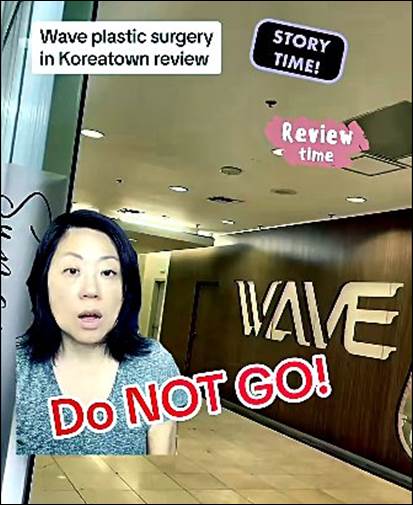
An “influencer” who posted a video on her TikTok account exposing purported rudeness of staff at a plastic surgery/laser treatment center facility, drawing more than 50,000 views, was errantly granted an anti-SLAPP motion, the Court of Appeal for this district has held, declaring that her commentary did not satisfy the first prong of the governing statute.
Code of Civil Procedure §425.16(e)(3) renders protected “any written or oral statement or writing made in a place open to the public or a public forum in connection with an issue of public interest.” Justice Matthew A. Scherb of Div. Eight said in Wednesday’s unpublished opinion that defendant Tina Kim “has not made a sufficient first-prong showing that her TikTok statements were in connection with a public issue or issue of public interest.”
The opinion reverses an order by Los Angeles Superior Court Judge Maureen Duffy-Lewis granting Kim’s special motion to strike the defamation/false light lawsuit brought by WAVE Plastic Surgery Center, Inc.
Kim asserted in her video that the plaintiff’s Koreatown office is a “horrible, horrible place” where she waited “like almost 15 minutes” with no employee paying any attention to her presence. Surveillance footage showed she was, in fact, greeted in the reception area and was on the office only about four minutes.
She also alleged on the video:
“There’s so many places in Koreatown, and WAVE is definitely on the list to do not go and they actually treated me the worst than any place I’ve walked into.”
2007 Opinion
In ruling for Kim, Duffy-Lewis relied upon the Third District Court of Appeal’s 2007 opinion in Gilbert v. Sykes which reverses the denial of an anti-SLAPP motion filed by Georgette Gilbert who was sued, in a cross-complaint, by medical doctor Jonathan Sykes. His plastic surgery on Gilbert caused the woman to create a website telling of her revulsion over the job he did.
“Sykes does not dispute that plastic surgery is a subject of widespread public interest and discussion,” Justice M. Kathleen Butz wrote in explaining why the content of the website related to a matter of public interest. She declared:
“Gilbert’s Web site contributed toward the public debate about plastic surgery in at least two ways: First, assertions that a prominent and well-respected plastic surgeon produced ‘nightmare’ results that necessitated extensive revision surgery contributes toward public discussion about the benefits and risks of plastic surgery in general, and particularly among persons contemplating plastic surgery as a means of looking younger or improving their appearance.”
Butz went on to say:
“Second, a review of the entire Web site shows that it is not limited to Gilbert’s interactions with Sykes. The Web site contains advice, information and a contact page where readers can share their own experiences….Clearly, the Web site… contributed to the general debate over the pros and cons of undergoing cosmetic surgery.”
Kim’s Contention
Kim, in urging an affirmance, argued:
“Here, the challenged statements— worst customer service,’ ‘horrible customer service,’ ‘do not go,’ ‘none of them greeted me,’ ‘I walked in nobody is there,’ ‘I’ve been standing here like almost fifteen minutes’—are classic consumer-review judgments expressed in colloquial, hyperbolic language.”
She said that under Gilbert, as well as a 2012 First District opinion, “courts treat this kind of Internet review language as the quintessential setting where listeners understand they are hearing a reviewer’s perspective.”
WAVE maintained:
“Gilbert involved speech at the core of an ongoing public controversy: patient safety at a medical institution. Ms. Kim’s video involved a brief customer-service interaction at a reception desk. It would be an understatement to say there is an ocean between the two.”
Scherb’s Opinion
Scherb wrote:
“WAVE has the better view.”
Differentiating the fact situation there from the one in WAVE’s action against Kim, Scherb said:
“Kim’s statements are unlike Gilbert’s. Neither Kim’s experience nor her video concerned the quality of WAVE’S plastic surgery providers, let alone furthered the kind of discussion Gilbert furthered.”
The justice noted:
“Kim’s statements do not implicate medical services or broader issues regarding plastic surgery. Kim was not a WAVE patient….”
He remarked:
“There is no dispute Kim’s TikTok statements were in a public forum….But statements made in public do not necessarily concern an issue of public interest meriting protection under the anti-SLAPP statute.”
The case is Wave Plastic Surgery Center v. Kim, B339455.
Copyright 2026, Metropolitan News Company