Thursday, September 3, 2026
Page 1
Class-Action Lawsuit in District Court Alleges Diet Products Understate Sugar Content
By a MetNews Staff Writer
|
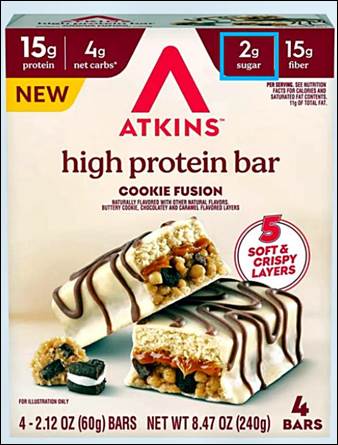
A company that manufactures various food products that represent on their labels that they contain either “1gm sugar” or “2 gm sugar” are lying, a putative class-action complaint filed by two San Diego residents in the U.S. District Court for the Southern District of California asserts.
The complaint was filed Tuesday against The Simply Good Foods Company, headquartered in Denver. Its products include those marketed under the Atkins brand—tied-in with the “Atkins diet”—and the Quest label.
The complaint alleges:
“Every Atkins snack and every Quest bar is sweetened with significant amounts of allulose—a sugar.”
It is specified that allulose “is a naturally occurring sugar in foods such as figs, raisins, maple syrup, and brown sugar.”
‘No Mystery’
The pleading sets forth:
“There is no mystery about the amount. The amounts vary by product and run as high as eight (8) grams per serving in the Atkins Products and eleven (11) grams per bar in the Quest Products. The Atkins Endulge Gummy Bears promise ‘<lg SUGAR’ while containing eight grams of allulose; the Quest Cookies & Cream Crispy bar contains eleven grams of allulose, roughly eleven times the amount of sugar its front label represents.”
Represented by attorneys Benjamin Heikali, Joshua Nassir, Ruhandy Glezakos, and Ammad Bajwa of Treehouse Law in Santa Monica, plaintiffs Sylvia Diana Amavisca and Joshua Jonathan Raoufpur is each said to have purchased a Simply Good Foods product in reliance on the package’s representation of scant sugar content. Amavisca purchased Atkins keto caramel almond clusters candies from Walmart’s, online, the pleading says, while Raoufpur bought Quest Cookies & Cream Crispy bars from a Ralphs store.
Allegations of Complaint
They seek to represent a California class and a multi-state class. The complaint sets forth:
“Defendant has deceived the public and has charged a premium for it. Consumers paid for the small amounts of sugar stated on the labels and received several times more. They were deprived of the benefit of their bargain: they would not have purchased the Products, or would have paid substantially less for them, had they known the truth. As such. Plaintiffs and Class members have been financially injured.”
The pleading continues:
“Plaintiffs bring this action on behalf of themselves and Classes of consumers in California and other states with materially similar consumer protection laws to recover damages and to enjoin Simply Good Foods’ unlawful conduct.”
Seventh Circuit Decision
The complaint says that whether allulose is a sugar is “no longer an open question,” pointing to the Seventh Circuit’s July 27 opinion in In Franco v. Chobani, LLC. That court declared that “allulose is a sugar” under the governing federal regulation.
It acted after seeking input from the Federal Drug Administration (“FDA”) which provided its advisement in an amicus brief. It said that all monosaccharides, including allulose, are sugars.
The opinion declares that “[w]e find the FDA’s reading of” the regulation “persuasive,” observing:
“The agency’s brief is thorough, its reasoning is valid, and its position is consistent with earlier FDA statements about allulose…”
Claims on behalf of the California class are for unjust enrichment/quasi-contract, intentional misrepresentation/fraud, and violation of the state’s Consumers Legal Remedies Act, Unfair Competition Law, and False Advertising Law.
A brief claim on behalf of the multi-state class sets forth that “Plaintiffs and the Multi-State Consumer Protection Class members were injured as a result of Defendant’s violations of state consumer protection statutes,” without citing any particular state laws.
The complaint enumerates eight Atkins products and nine produced under the Quest label.
It seeks class certification and “[a]n order enjoining Defendant from continuing to label, advertise, or market the Products with ‘<1G SUGAR,’ ‘ZERO GRAMS ADDED SUGAR,’ ‘lg SUGAR’ ‘2g SUGAR,’ or any other sugar content claim that misstates or understates the Products’ sugar content as defined by federal and California law, and requiring corrective disclosures,” in addition to damages of various sorts, attorney fees, and interest.
The case is Amavisca v. The Simply Good Foods Company, 26-CV-04971.
A comment was sought from Simply Good Foods’ chief legal and corporate development officer, Timothy R. Kraft, but no response was received.
Copyright 2026, Metropolitan News Company