Monday, October 5, 2026
Page 3
Enforceability of ‘Safe Worship Zone Act’ Draws Challenge
Action Is Filed in District Court Arguing That New Measure Would Criminalize Constitutionally Protected Activity
By a MetNews Staff Writer
|
|
|
ALEX STEIN comedian/commentator |
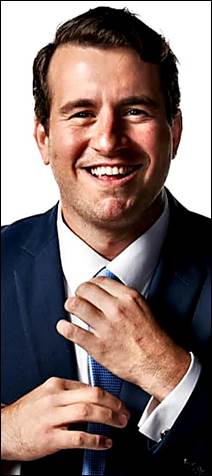
A comedian/political commentator has filed suit in the U.S. District Court for the Central District of California seeking to block enforcement of the Safe Worship Zone Act, signed into law on Sept. 25, arguing that it would prevent him from engaging in assertedly constitutionally protected activity such as holding a sign reading “Gays for Palestine” in front of a synagogue and obtaining persons-on-the-street reactions from passersby.
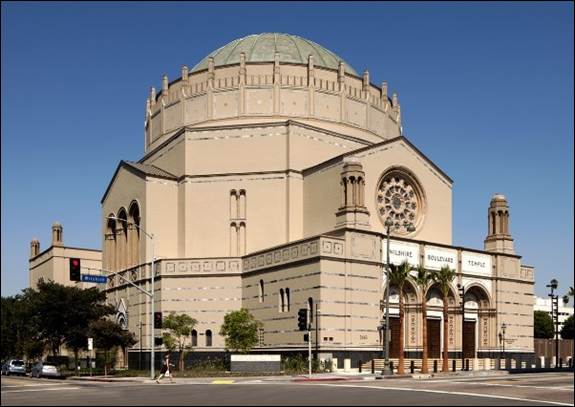
The particular synagogue plaintiff Alex Stein mentions in his complaint, filed Thursday, where he wants to conduct interviews, at the Wilshire Boulevard Temple at 3663 Wilshire Boulevard, three blocks east of Western Avenue. That landmark structure—long associated with a prominent local figure, Rabbi Edgar Magnin, who died in 1984—was the site of a Dec. 3, 2025 pro-Palestinian demonstration that turned violent.
It was at that synagogue that Gov. Gavin Newsom, in a ceremony, signed into law Assembly Bill 2664, creating the provision Stein contests. He said, at that time:
“Every Californian should be able to walk into a synagogue, church, mosque, or other house of worship without fear. California is continuing to protect these organizations and the people they serve, and we’re strengthening that work from the front door to expanding security resources to community events statewide.”
Single Incident
Stein says, in a complaint signed by attorney Mark L. Javitch of the Jewish Community Advocacy Council in San Mateo, that the legislation, slated to go into effect Jan. 1, “was enacted in 2026 in response to a protest at a single Los Angeles place of religious worship, at which participants blocked access, prevented people from leaving, and engaged in conduct for which arrests were made.”
The pleading sets forth:
“That conduct was already unlawful when it occurred. The Legislature enacted the Act notwithstanding objections that its criminal penalties would chill peaceful protest when places of worship host political or other events.”
Wording of Provision
The legislation adds §594.38 to the Penal Code. It provides, in subd. (c), that [w]ithin a radius of 100 feet from an entrance or exit of a place of religious worship, a person shall not, without consent, intentionally approach another person seeking to enter or exit a place of religious worship within 8 feet of that person to do either of the following: [¶] (1) Pass a leaflet or handbill to, display a sign to, or engage in oral protest or education with the other person.”
Stein’s complaint scoffs:
“A person cannot obtain another’s consent to be approached without first approaching to ask. The Act therefore prohibits the very approach by which consent would be sought.”
The statute says, in subd. (e);
“ (1) A first violation of this section is a misdemeanor, punishable by a fine not exceeding one thousand dollars ($1,000), imprisonment in a county jail not exceeding six months, or by both that fine and imprisonment. [¶] (2) A second or subsequent violation of this section is punishable by a fine not to exceed five thousand dollars ($5,000), by imprisonment in a county jail for a period of not more than one year, or by both that fine and imprisonment.”
|
|
|
Pictured is the Wilshire Boulevard Temple, site of a protest that led to legislation that is under attack in a U.S. District Court action. |
The plaintiff—who named as defendants state Attorney General Rob Bonta and Los Angeles County District Attorney Nathan Hochman—says in his complaint that he “intends to approach members of the public on the public sidewalk—including persons seeking to enter or exit the Temple—come within 8 feet of them, display his signs to them, offer them a leaflet or handbill, and ask whether they will share their views with him.”
He acknowledges:
“Passing a leaflet, displaying a sign, and engaging in oral protest or education are each acts subdivision (c)(1) prohibits, and Plaintiff intends to engage in all three.
Offensiveness Not Relevant
The complaint continues (with paragraph numbering omitted):
“Plaintiff’s sign, questions, and commentary are satirical political expression concerning matters of public concern, and his purpose is to gather and publish the views of ordinary members of the public. Plaintiff’s message is deliberately provocative and may be found offensive by some who encounter it. The offensiveness of protected speech is not a basis on which the government may restrict it.
“Although Plaintiff’s message is provocative in content, his intended conduct is peaceful and non-obstructive. He does not intend to obstruct or interfere with anyone’s entry to or exit from any place of religious worship, to impede pedestrian or vehicle traffic, or to threaten, harass, or intimidate anyone. If a person declines to speak with him or asks him to stop, he will immediately disengage.
“Plaintiff intends to engage in this activity on or shortly after the Act’s January 1, 2027 effective date, and on an ongoing basis thereafter. But for the Act, he would do so free of any fear of prosecution. He will not do so as planned, however, because he reasonably fears arrest and criminal prosecution under the Act for displaying his signs to, or approaching within 8 feet, persons seeking to enter or exit the Temple while he stands on the public sidewalk within 100 feet of an entrance or exit.”
Public Sidewalk
The pleading declares:
“The public sidewalk is the most traditional of all public forums, and leafleting, sign-holding, and one-to-one conversation are among the most traditional of all forms of public expression.”
It says Subd. (c) reaches “core protected speech directly, criminalizes it without regard to whether it causes any harm, and does so around every one of the thousands of places of religious worship in California.”
Stein “brings this action to vindicate his right, and the rights of all Californians, to speak, pass out leaflets, display signs, and gather the views of others in the public square,” the complaint avers.
From 2023-25, the plaintiff hosted the podcast series, “Prime Time with Alex Stein.”
The case is Stein v. Bonta, 2:26cv11406.
Copyright 2026, Metropolitan News Company