Thursday, January 15, 2026
Page 3
Court of Appeal:
Judge Erred in Placing Constraint on Public Records Release
Opinion Says Death Row Inmate Is Entitled to Unrestricted Access to San Bernardino County’s Files on 1974 Case for Which Prosecutors Say They Will Not Charge Him, Any Privilege Is Waived by Disclosure to Victim’s Family
By a MetNews Staff Writer
|
|
|
THOMAS CREECH murderer |
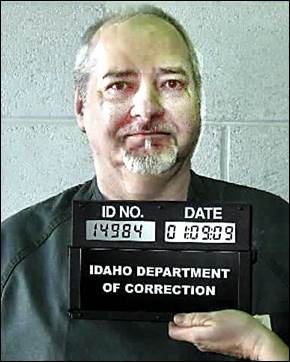
Div. Two of the Fourth District Court of Appeal has held that death row inmate who requested, pursuant to public records request, unfettered access to San Bernardino County’s files relating to a 1974 homicide—for which prosecutors say they will not be filing charges despite public assertions that he is the perpetrator—was wrongly given the information under a protective order precluding him from sharing the information.
Acknowledging that an investigative-records exemption and a privilege protecting “official information” in the possession of a state agency might have otherwise prevented full and free access to the materials, the court declared, in an unpublished opinion, that the county waived its rights to prevent disclosure by sharing the information with the victim’s family.
Justice Carol D. Codrington authored Tuesday’s decision, joined in by Acting Presiding Justice Art W. McKinister and Justice Douglas P. Miller, saying:
“The…file lost its exempt status under the [California Public Records Act] when the County knowingly and voluntarily provided it to the [victim’s] family….The…file thus became ‘completely public,’ meaning it became ‘open to public scrutiny’ and usable by any member of the public for any lawful purpose….The trial court thus had no authority to place restrictions and limitations on its use, including those in its protective order.”
Botched Execution Attempt
Seeking full access to the documents was Thomas Creech, who survived an execution attempt by the State of Idaho in February 2024 when medical personnel were unable to find a suitable vein for the intended lethal injection. In total, Creech has been convicted of five murders, including the fatal beating of fellow inmate, David Jensen, in 1981, for which he was sentenced to death; new legal challenges have delayed any future capital punishment plans.
He has openly admitted to killing or participating in the deaths of somewhere between seven and 26 people across more than a half-dozen states. Before the botched execution attempt, he was granted a clemency hearing before the Idaho Commission of Pardons and Parole in January 2024.
During the proceedings, prosecutors informed the agency that Creech had been identified as the perpetrator of the 1974 California murder of Daniel Walker, who had been sleeping in his car in San Bernardino on a road trip home to Colorado when he was ambushed and shot. The defendant said that he was surprised by the accusation.
After the hearing, the San Bernardino County Sheriff’s Department and District Attorney’s Office made statements to the media identifying Creech as Walker’s killer, indicating that the inmate had made statements connecting him to the shooting, but commenting that they were not seeking to prosecute him due to the “jurisdictional issues.”
Public Records Act Request
Following the public statements, Creech sought investigative files from the county under the California Public Records Act (“CPRA”), codified at Government Code §6250 et seq., sending demand letters to the sheriff and local prosecutor requesting all communications about him with Idaho law enforcement agencies, and all documents concerning the shooting, including all correspondence with the victim’s family.
After the request only yielded one letter by the San Bernardino County District Attorney’s Office to the Idaho prosecutor, Creech filed a petition for a writ of mandate in the trial court. The county agencies asserted that the documents were covered by the CPRA’s investigative-records exemption, found at Government Code §7923.600.
That section provides:
“[T]his division does not require the disclosure of records of complaints to, or investigations conducted by,…any state or local police agency…for correctional, law enforcement, or licensing purposes.”
On Feb. 28 of last year, San Bernardino Superior Court Judge Michael A. Sachs ordered the county to disclose to Creech approximately 3,000 pages of investigative records that had previously been given to Walker’s family members. However, he ordered the release subject to a protective order that specified that neither the defendant nor his attorney may publicly disclose the materials.
Sachs said that he was “not convinced that these documents [released to Walker’s family] are such that they should be released to the world” but that the inmate was entitled to use the reports “to assist him in his efforts to seek clemency or any type of relief’ in court. The judge denied Creech’s petition as to the clemency-related documents, finding that there was no evidence that such documents existed.
Broadly Defined
Codrington noted that the CPRA broadly defines “public records” to include “any writing containing information relating to the conduct of the public’s business prepared, owned, used, or retained by any state or local agency.”
Saying that “the County effectively concedes, and we agree, that the trial court found (at least implicitly) that the County waived any right to withhold the file from Creech under the CPRA’s investigative-records exemption by giving the…file to the Walker family,” she cited case law establishing that a disclosure of the target materials to a member of the public will constitute a relinquishment of the statutory right to refuse a later request for release.
She added:
“When, as here, a party waives its right to exempt records from disclosure that otherwise should be disclosed under the CPRA, the records must be disclosed….This is because records are either ‘completely public or completely confidential’ for CPRA purposes….Thus, our Supreme Court held over 40 years ago that ‘once information is held subject to disclosure under the [CPRA], the courts can exercise no restraint on the use which it may be put.’ ”
Rejecting San Bernardino County’s additional claim that the files were protected under Evidence Code §1040, which shields “official information” acquired “in confidence by a public employee in the course of…duty and not open, or officially disclosed, to the public,” the jurist remarked:
“The parties strenuously dispute whether the trial court imposed the protective order under section 1040. We agree with Creech that nothing in the court’s statements…suggest that it relied on section 1040 to impose the protective order….Assuming the trial court relied on section 1040 to impose the protective order, as the County contends, we conclude [it] erred in doing so.”
Privilege May Be Waived
Pointing out that, “[l]ike any other privilege, the official information privilege may be waived,” she wrote:
“[T]he purpose of the privilege is ‘to enable the government to protect its secrets.’ But the Walker file is now public information in the hands of the Walker family, so the County can no longer maintain any secrecy in the file….[W]e agree with Creech that the County cannot now claim that the Walker file is nonpublic information that has not been ‘officially disclosed’ to the public.”
Commenting that “[t]here is…no dispute that the County and its Idaho counterparts were in communication about Creech,” she concluded that “[t]he trial court here incorrectly found that no clemency-related communications existed” and directed the court to consider, on remand, whether any such documents are exempt from disclosure. Codrington declared:
“Let a peremptory writ of mandate issue directing the trial court to vacate its February 28, 2025 order on Creech’s CPRA petition and the court’s corresponding protective order. The matter is remanded to the trial court to conduct further proceedings consistent with this opinion.”
The case is Creech v. Superior Court (San Bernardino County), E085656.
Copyright 2024, Metropolitan News Company