Tuesday, March 24, 2026
Page 1
Court of Appeal:
Fragment of Expressive Work Is Subject to Protection
Justices Say Incidental Use of Celebrity’s Likeness in Cartoon Depicting LGBTQ Spies Is Not Actionable
By a MetNews Staff Writer
|
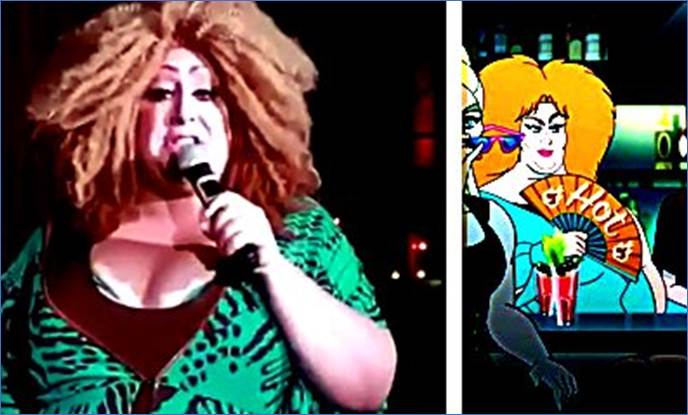
The fleeting unauthorized use of the likenesss of a recognizable figure in a single scene within an animated video, and utilization of a clip of that depiction in a promotional trailer, as well employment of a still frame in advertising, did not intrude upon the publicity rights of the person whose likeness appeared, Div. Five of this district’s Court of Appeal has held.
In reversing an order denying an anti-SLAPP motion brought by Netflix and others, Div. Five declared, in an unpublished opinion filed Friday, that because the cartoon is an expressive work, even a fragment of it is entitled to First Amendment protection, precluding the success of a special motion to strike.
Suit was initially brought by Lance Hara, who performs as drag queen Vicky Vox. on May 5, 2023, in the U.S. District Court for the Central District of California, A cartoon character resembling her appears in a 10-second segment of a 10-episode 2021 series, “Q-Force,” featuring LGBTQ spies.
West Hollywood Bar
A Vox-like character, with red-orange hair, is in a scene set in a bar in West Hollywood. It shows her, seated in the background with four other drag queens, engaged in a union meeting.
She is using a hand-held “thworp” fan—the name simulating the sound it makes in being flicked—with “Hot” written on it. A thworp fan is customarily used by Hara in her act, often performed in West Hollywood.
Her likeness was also used in advertising the series, in a trailer on YouTube and in a still shot.
Judge R. Gary Klausner on Oct. 26, 2023, dismissed with prejudice Hara’s action for infringement under the federal Lanham Act and dumped her state-law claims for lack of subject-matter jurisdiction. The Ninth U.S. Circuit Court of Appeals affirmed on July 28, 2025.
Circuit Judge Gabriel P. Sanchez wrote for a three-judge panel in concluding that there was no infringement because “Defendants used Vox’s image and likeness solely in an expressive manner to lend reality to the setting where part of the series takes place, not to designate Vox as the source or origin of Q-Force.”
A complaint was filed in the Los Angeles Superior Court on Nov. 9, 2023. Judge Jon R. Takasugi on June 28, 2024, held that Hara’s action could proceed under the three causes of action she pled: California’s right-of-publicity statute, Civil Code §3344, the common law right of publicity, and invasion of privacy by appropriation.
He ruled that the first prong of the anti-SLAPP statute, Code of Civil Procedure §425.16—a requirement that the action stems from defendant having engaged in protected conduct—was met, explaining that “Plaintiff is a public figure in a defined subculture, and her alleged inclusion in the series was connected to a matter of public interest.”
Takasugi went on to determine that the second prong—a showing by the plaintiff of minimal merit—was also satisfied, rejecting the defendants’ contention that Hara’s likeness was used in an expressive manner. The judge set forth:
“Plaintiff’s evidence (and allegations) could show that Defendants depicted Plaintiff without any commentary and without any actual expressive aims. Instead, Plaintiffs allegations could show that Defendant’s actual underlying aim in using Plaintiff’s likeness in the series was to appropriate, without compensation, Plaintiff’s image and character for the purpose of commercial promotion for an underlying audiovisual work and for wholly unrelated goods and services.”
He continued:
“Plaintiff was featured prominently in the advertisements, with Plaintiff’s likeness, image, and identity remaining on screen for more than 12% of the duration, and prominently featured in the stills, taking up more than 20% of the frame….As such, Plaintiff was prominently billed in the advertisement of the series, while being virtually non-existent in the series itself.”
Appeals Court Opinion
In reversing the denial of the anti-SLAPP motion, Div. Five’s opinion, authored by Justice Lamar Baker, says:
“Q-Force is an expressive work. Vox’s alleged likeness was not the sum and substance of Q-Force, but merely one of many raw materials defendants used in telling a part of the larger Q-Force story. As such, defendants’ actions merit First Amendment protection that bars any possibility that Vox could prevail on the merits of any of her claims.”
Baker reasoned that “[t]he character is, effectively, part of the setting, and is part of what makes the setting feel more real.” He elaborated that “[t]he character is a small part of the larger story” which is expressive, adding that “the likeness was transformed into part of a greater creative product.”
Respondent’s Brief
Hara argued in its brief on appeal that a “defense is not available for defendants who simply recreate a public figure’s likeness in the very setting in which he has achieved renown, as Defendants have done here,” contending:
“Here, Defendants simply recreated Plaintiff’s likeness and plagiarized her Vicky Vox character as a cartoon, and then plugged this animated facsimile of the Vicky Vox persona into the very setting in which Plaintiff worked to achieve her renown: a West Hollywood gay bar. As fully alleged in the Complaint, Defendants used Plaintiff’s fame to garner attention for the Series and unrelated goods and services through prominently displaying Plaintiff’s likeness in various forms of commercial speech. As a result and as correctly decided by the trial court, Plaintiff can easily establish her prima facie case.”
Baker responded:
“Q-Force did not duplicate one of Vox’s acts or otherwise replicate her in a way that would substitute for one of her performances with her drag band, or one of her hosted events. Rather, it used her alleged likeness as a background character to ground the West Hollywood setting of the episode. Vox does not allege she is ‘well-known’ because she sits in bars with other drag queens or because she attends drag queen union meetings. Rather, she alleges she is well-known for hosting VIP events and appearing in her drag band. That the background character in Q-Force appears in a West Hollywood bar does not make the alleged use of Vox’s likeness one that appropriates the economic value she stands to generate from her character or reputation.”
The case is Hara v. Netflix, B340401.
Copyright 2026, Metropolitan News Company