Monday, April 20, 2026
Page 1
Judge Grants Dismissal Motion in ‘Highly Unusual’ Case
Ohta Says Hochman May Drop Prosecution of Two Torrance Police Officers on Voluntary Manslaughter Charges
By a MetNews Staff Writer
|
|
|
Pictured is Torrance police officer Anthony Chavez. Los Angeles Superior Court Judge Sam Ohta has granted a motion by the District Attorney's Office to drop voluntary manslaughter charges against Chavez and fellow officer Matthew Concannon. |
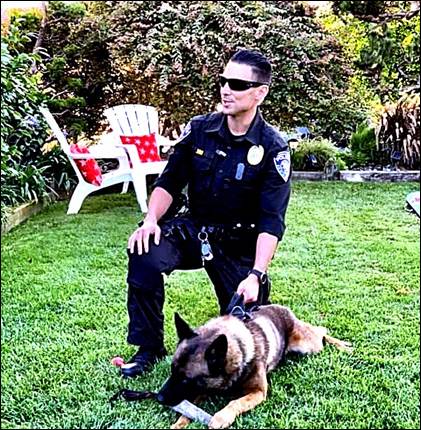
Los Angeles Superior Court Judge Sam Ohta, in what he termed “a highly unique case,” has granted a motion by the office of District Attorney Nathan Hochman to dismiss, in the interests of justice, voluntary manslaughter charges brought under the administration of his predecessor against two Torrance police officers.
The shooting by the officers, Matthew Concannon and Anthony Chavez, took place on Dec. 9, 2018. Christopher Deandre Mitchell was spotted in a parking lot in a vehicle that had been reported as stolen.
As the officers approached, it appeared he had a rifle between his legs. They ordered him to keep his hands up; instead he moved his hands from the steering wheel toward the weapon; they fired, killing him.
It turned out the weapon was merely a pellet rifle.
Lacey’s Office Investigates
The office of then-District Attorney Jackie Lacey investigated and exonerated the officers. Lacey was defeated at the polls in 2020 by George Gascón who appointed a special prosecutor, civil rights attorney Lawrence S. Middleton, to reexamine the shooting.
On March 24, 2023, a grand jury indicted the officers. Hochman defeated Gascón in 2024, appointed his own special prosecutor, Playa del Rey attorney Michael Gennaco, who investigated anew, finding insufficient evidence of wrongdoing.
The district attorney moved for a dismissal under Penal Code §1385, saying his office could not establish guilt beyond a reasonable doubt, while Marsy counsel for Mitchell’s family insisted that no meaningful investigation by Gennaco had taken place and Hochman was simply seeking to protect the officers.
Ohta’s Ruling
Several hearings were held before Ohta. He granted the motion to dismiss on Thursday in a 34-page decision.
Ohta observed:
“When candidates for the Office of the District Attorney seek to be elected, they make campaign statements on their prosecutorial philosophy to distinguish themselves from other including any incumbent in office. While many factors go into a candidate’s election victory, the candidate’s representations on their prosecutorial philosophy are certainly one of them. Thus, in winning, former District Attorney, Mr. Gascon was generally considered a progressive district attorney, and current District Attorney. Mr. Hochman, mostly as a traditional district attorney. It is not unusual nor is it unexpected for the newly elected district attorney to implement changes in the office and on existing cases through the exercise of his independent executive discretion based on prosecutorial philosophy communicated to the public who elected him.”
Two Alternatives
Addressing the competing contentions, he said:
“Primarily, two alternatives explain the special prosecutor’s application to dismiss: (1) the current District Attorney is exercising independent executive discretion applied to case specific analysis based on prosecutorial philosophy, and (2) the District Attorney has abandoned his duty of independence by failing to conduct appropriate case specific analysis because of his institutional bias in favor of law enforcement. The trial court does not have before it admissible evidence that the District Attorney has abandoned his independence and his duty to apply appropriate case specific analysis because of his institutional bias in favor of law enforcement.”
The judge went on to say:
“[T]hree different elected district attorneys have made decisions affecting the criminal status of this incident. This case is uniquely situated at the intersection between those who believe in police reform and those who hold traditional views on law enforcement That this case received publicity is unfortunate for both the victim’s family and the defendant: who care not about public perception but only seek justice.”
Separation of Powers
Ohta declared:
“In a case where no clear and admissible evidence is before the court that executive prosecutorial discretion has improperly been abandoned, however, this court must remain true to is constitutional role to decide cases and controversies based on admissible evidence and not substitute its judgment for that of the executive branch. To do so based on conclusion and argument would be to violate the separation of powers doctrine by defeating or materially impairing the inherent function of another coordinate branch of government.
“Instead…, the California Constitution under Article V, § 13 has textually committed direct supervision of all the state’s district attorneys within the executive branch to the Attorney General. Claims regarding district attorney misconduct not clearly supported with admissible evidence must first be investigated, if at all, by the slate’s Attorney General, who by constitutional mandate is the district attorney’s direct supervisor. This is the proper functioning of California’s constitutional system.”
The case is People v. Concannon, BA498475.
Copyright 2026, Metropolitan News Company