Wednesday, April 15, 2026
Page 1
Court of Appeal Upholds Murder Convictions of Couple Though No Body Was Found
Justices Say Circumstantial Evidence Was Strong Enough to Support Verdicts
By a MetNews Staff Writer
|
|
|
JENNIFER WEST |
|
|
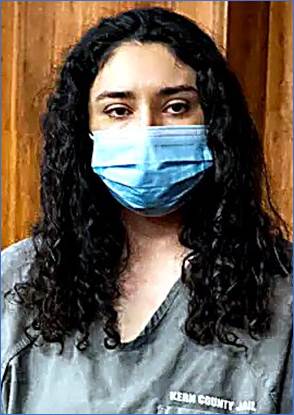
The Fifth District Court of Appeal yesterday affirmed the second-degree murder convictions of the adoptive parents of a four-year-old boy whose body was never found, with the jurists declaring that circumstantial evidence was strong enough to support the verdicts.
Defendants Trezell and Jacqueline West, of Kern County’s California City, telephoned police on Dec. 21, 2020 to report that Orrin West, 4, and his brother, Orson West, 3, had been playing in the backyard and had apparently wandered off. Neither child was found.
The couple’s other four children told police that the two boys had not been seen for several weeks. Adrian West, 10, oldest of the youngsters, told police, and later testified before the grand jury, that one night, he heard Orrin, in his bedroom, making noises, as if choking, and the next morning, vomit was emitting from his nose.
He recounted the parents saying they “took care” of Orrin’s body.
The prosecution’s theory was that Orrin was alive in the morning but died owing to the adoptive parents’ failure to call for medical help.
While both defendants were convicted of the second-degree murder of Orrin, they were deadlocked as to whether there had been a homicide of Orson, whose absence occurred after that of his older brother.Convictions of the two defendants, with modifications, were affirmed in separate but nearly duplicate opinions by Justice Herbert I. Levy, who wrote:
“Because Orrin’s body was never recovered, the precise time and actual cause of his death cannot be determined. But the absence of that precision does not defeat causation. The law does not require such proof to a mathematical certainty….Instead, criminal liability turns on proximate causation—whether the evidence permits a reasonable inference that defendants’ conduct, or their omission, set in motion a chain of events resulting in death as a direct, natural, and probable consequence, and death would not have occurred without it….
“Here, the evidence permitted the jury to infer that Orrin was alive but in obvious and grave medical distress, defendants recognized the need for assistance, but they nevertheless chose not to seek help despite their legal duty to do so. From these facts, the jury could reasonably conclude that leaving a critically endangered child without care made death the foreseeable and natural result, and that the fatal outcome would not have occurred when it did had defendants filled their duty.”
The justice made note of the California Supreme Court’s Jan. 6, 2025 opinion in People v. Collins in which Justice Kelli M. Evans wrote for the majority in reversing a second-degree murder conviction, reciting that mere suspicion is insufficient to support a judgment. Levy wrote:
“Our high court explains that the weight of the evidence must be considered before a reviewing court may defer to the jury’s conclusions drawn from the record….Here, the totality of the circumstances permitted the jury to reasonably infer that defendants knew they were responsible for Orrin’s death. Defendants instructed Adrian to keep the choking incident secret, and they concealed Orrin’s and Orson’s whereabouts from family and authorities. They provided false accounts to law enforcement and the media and perpetuated a fabricated narrative that the children were with relatives, but nothing at trial demonstrated or even reasonably suggested that anyone else ever watched the children in 2020.”
That, and other circumstances, “supplied sufficient weight for the jury to conclude beyond a reasonable doubt that defendants deliberately concealed the homicide they committed,” he said.
The cases are People v. Jacqueline Gabrielle West, F086995, and People v. Trezell West, F087184.
Copyright 2026, Metropolitan News Company