Monday, October 5, 2026
Page 1
Dispute Over Netflix’s 2024 ‘Mary’ Release Fails to Survive Anti-SLAPP Scrutiny—C.A.
Opinion Says Trial Judge Wrongly Found That Action Against Producer of Film About Biblical Figure Over Earlier Contract About Different Script Has Minimal Merit
By a MetNews Staff Writer
|
|
|
Depicted is a promotional poster for the 2024 Netflix release “Mary.” On Thursday, the Court of Appeal for this district found that a plaintiff’s complaint asserting that a filmmaker associated with the film violated an earlier agreement concerning a joint venture to make a similarly themed motion picture is a SLAPP. |
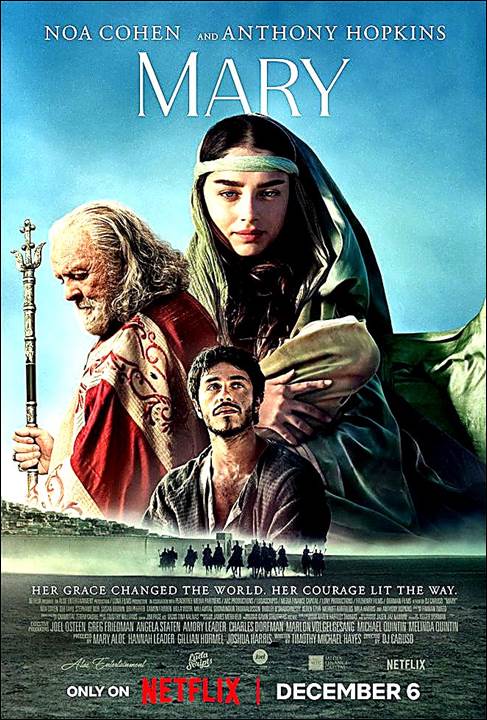
Div. Three of this district’s Court of Appeal has reversed an order denying anti-SLAPP relief to a filmmaker behind Netflix’s 2024 release of the film “Mary,” which stars two-time Oscar winner Anthony Hopkins as King Herod, saying a Los Angeles Superior Court judge erred in finding minimal merit to allegations that the defendant had breached a settlement agreement concerning a similar project about the biblical figure that was based on a different script.
The plaintiff, Mary Film LLC—a successor in interest to Rafael Film Fund LLC, a joint venture formed in 2014 between production companies affiliated with Mary Aloe, on the one hand, and Leo Severino, on the other, to make a film about the mother of Jesus—asserted that the Aloe parties had breached a settlement agreement reached in 2018 after the relationship between the producers soured.
In the agreement, the parties acknowledged that Rafael Film held the rights to the joint project by virtue of an earlier assignment and, in paragraph four, specified that the Aloe parties “covenant” not to, without the express written consent of the Rafael parties, “make any representation…regarding or relating to the Picture to any third party,” “enter into any contract…relating to the Picture,” or “make any statements to the press…regarding or relating to the Picture.”
Mary Film LLC asserted a breach of the provision by the Aloe parties in a November 2024 complaint relating to their involvement in the Netflix film, asserting that the defendants could not produce that picture without making “representations” or “entering into contracts” in violation of the fourth paragraph.
Reading of Complaint
Los Angeles Superior Court Judge Mark H. Epstein construed the plaintiff’s breach of contract cause of action as including allegations that the Netflix film used intellectual property associated with the original project and found that there was minimal merit to the claim that the 2024 release was substantially similar enough to infringe on those rights.
Friday’s unpublished opinion, authored by Presiding Justice Rashida A. Adams, rejects that view and declares that the contractual term, “the Picture,” is ambiguous as to whether it extends broadly to incorporate all ideas and elements underlying the 2013 project. Adams said:
“Consideration of the entire agreement as a whole does not support Mary Film’s argument that the agreement was intended to delineate or further protect the Rafael Parties’ exclusive rights to use the story ideas, themes, or concepts underlying the jointly produced ‘Mary’/‘Mary Mother of Christ’ film. Read in context, Paragraph 4’s provisions…appear to relate to the specific co-production, based on the 2013 screenplay, not an amorphous set of intellectual property rights.”
California’s anti-SLAPP statute, found at Code of Civil Procedure §425.16, provides:
“A cause of action against a person arising from any act of that person in furtherance of the person’s right of petition or free speech…in connection with a public issue shall be subject to a special motion to strike, unless the court determines that the plaintiff has established that there is a probability that the plaintiff will prevail on the claim.”
Elements of Film
Noting that the sole issue on appeal was whether Mary Film had shown a probability of prevailing, Adams pointed out that the plaintiff asserted that “the Picture” includes both the film “that the Rafael Parties were in the process of producing” when they entered into the settlement agreement and all ideas, themes, subject matter, and other “elements” relating to the project.
Unconvinced, the jurist opined:
“The settlement agreement does not indicate what specific elements constitute the ‘feature film project.’ Critically, it does not specify whether the term encompasses both tangible materials (e.g., scripts, screenplays) and intangible work product (e.g., stories, themes, and subject matter) derived from or related to the project.”
She highlighted that “[t]he complaint alleged only claims based on Paragraph 4 of the settlement agreement” and said that a now-expired non-disclosure agreement between the parties showed that “the parties knew how to express their intention to broadly prohibit the production of films based on the same general conceit as their co-production.” Under those circumstances, she opined:
“[A]lthough the plain language of Paragraph 4 is ambiguous, the entirety of the agreement and the extrinsic evidence the parties have proffered demonstrate that the agreement is not reasonably susceptible to the interpretation urged by Mary Film.”
Implied Covenant
As to the breach of the implied covenant of good faith and fair dealing claim, she wrote:
“Paragraph 4 of the settlement agreement did not prevent the Aloe Parties from creating a competing film based on the same subject, themes, and narrative as the Mary Project. Thus, the settlement agreement did not entitle Mary Film to the right to receive the benefit of noncompetition. In the absence of any express contractual obligation to this effect in the settlement agreement, Mary Film cannot maintain its cause of action based on the implied covenant of good faith and fair dealing.”
The case is Mary Film LLC v. Aloe, B346466.
Richard M. Rosenthal and Valentina Kudryavtseva of the Beverly Hills-based Law Office of Richard M. Rosenthal acted for the Aloe parties. Alexander Rufus-Isaacs of Rufus-Isaacs Acland & Grantham LLP, also based in Beverly Hills, represented the plaintiff.
The “Mary” film reached more 24.6 million views in the first 10 days after its release, according to the streaming giant.
Servino alleged that his production company was working on a feature film titled “Bethlehem,” based on Herod’s persecution of Mary, when he learned, in April 2024, about the upcoming Netflix release. He said that an investor jumped ship after learning about the competing project.
Copyright 2026, Metropolitan News Company