Monday, August 24, 2026
Page 1
Ninth Circuit Says California Lacks Standing to Contest Loophole in U.S. Ghost-Gun Rule
Opinion Says Judge Wrongly Voids Language That Carves Out Sale of Certain Assault-Rifle Parts From Firearm Registration Requirements Because State Did Not Establish Any Concrete Injury
By a MetNews Staff Writer
|
The Ninth U.S. Circuit Court of Appeals held Friday that California lacks standing to challenge a federal rule regulating the sale of so-called “ghost guns”—or firearms typically built at home from kits or parts—over an alleged loophole that purportedly allows consumers to purchase significant portions of an AR-15-type weapon without a serial number or a background check on the purchaser.
The decision vacates an order by Senior District Court Judge Edward M. Chen of the Northern District of California granting summary judgment for the state and a gun-control group that collectively argued that the rule was arbitrary and capricious in violation of the Administrative Procedure Act (“APA”) in its exemption of the AR-15 parts. Chen’s Feb. 26, 2024 order provides:
“The Court…: (1) declares one subsection of the final rule…and related agency actions to be unlawful and enjoins Defendants from enforcing them; (2) vacates one subsection of the final rule….”
Circuit Judge Consuelo M. Callahan authored the opinion, joined in by Judges Holly A. Thomas and Anthony D. Johnstone, saying:
“Although California [and the advocacy group] expended resources to combat the spread and use of ghost guns after enactment of the Final Rule, those expenditures were based on their predictions that [the challenged language] would cause increased use by third parties of the products at issue in an unlawful manner. But we cannot ‘endorse standing theories that rest on speculation about the decisions of independent actors…particularly speculation about future unlawful conduct.’…Because [the plaintiffs] assert theories that rest on such speculation, neither has standing here.”
At issue is a 2022 regulation relating to the Gun Control Act of 1968 which imposes background check, licensure, as well as serialization requirements on firearm dealers and defines covered weapons to include “frames” and “receivers,” or those portion of a gun that house internal action components like the hammer and firing mechanism.
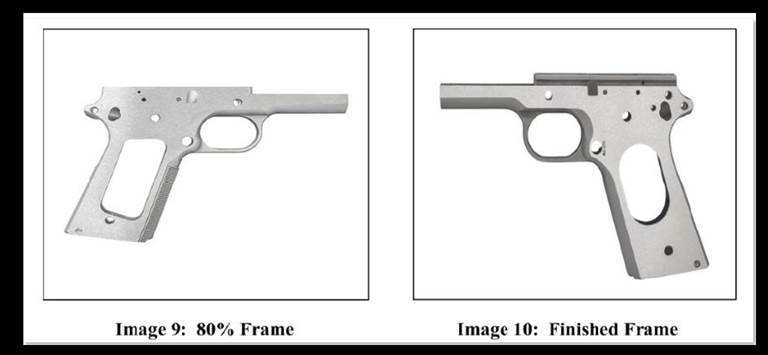
In 2020, California, together with the Giffords Law Center to Prevent Gun Violence (“GLC”), filed a lawsuit challenging a determination by the U.S. Bureau of Alcohol, Tobacco, Firearms, and Explosives (“ATF”) that products marketed as “80% frames” are not covered by the act. The plaintiffs cited an explosion of the use of so-called “ghost guns” in the years preceding the filing.
After President Joe Biden took office, ATF adopted a new rule, expanding the definition of frames and receivers to capture the parts being sold in ghost-gun kits and providing illustrations of what type of fragments are captured by the new scheme. Example 4 specifies:
“A bullet or blank of an AR-15 variant receiver without critical interior areas having been indexed, machined, or formed that is not sold, distributed, or possessed with instructions, jigs, templates, equipment, or tools such that it may readily be completed is not a receiver.”
Amended Pleading
In 2023, the plaintiffs filed an amended pleading attacking Example 4 under the APA, asserting:
“Defendants have allowed ghost guns to proliferate because they have determined that the core component of a ghost gun is not a ‘firearm’ under the GCA. That core component is a product that the ghost gun industry calls ‘80 percent’ ‘receivers’ for long guns or ‘frames’ for handguns.”
Noting that “80 percent’…receivers…require mere minutes to go from ‘unfinished’ to ready-to-fire,” they added:
“Though the Final Rule takes important steps to eliminate ghost gun-making ‘kits’—meaning where 80 percent receivers or frames are sold together with other essential firearm parts, such as the magazine to store ammunition, and the jigs to assemble the firearm—the Rule still permits the selling of unserialized ‘80 percent’ receivers and frames as stand-alone items without any background checks or serialization.”
Chen found that they had alleged sufficient facts to establish standing and declared:
“[T]he Court agrees with Plaintiffs that ATF’s actions related to Example 4 are arbitrary in capricious in failing to take into account all…factors related to the ‘readily’ assessment…and in failing to address the impact of easy availability of, e.g., jigs and tools from sources other than the seller or distributor of the incomplete receiver.”
Concrete Injury
Callahan noted that, under Article III of the Constitution, a plaintiff seeking relief in federal court must establish that it has suffered, or is likely to do so in the future, a concrete injury that is fairly traceable to the challenged action and capable of redress by a favorable ruling. She explained:
“When, as here, a plaintiff’s alleged harm results only as an indirect effect of the government’s ‘allegedly unlawful regulation…of someone else,’ ‘standing is not precluded, but it is ordinarily [hard] to establish.’…In such a case, proving causation requires a plaintiff to demonstrate that ‘third parties will likely react in predictable ways that in turn will likely injure the plaintiffs.’ ”
California and GLC argued that Example 4 caused both entities to increase financial expenditures, with the state claiming that it had “to accelerate implementation of State legislation regulating ghost gun parts” as well as divert resources to train law enforcement about the problem and the advocacy group saying that the rule forced it to increase spending on efforts to combat the widespread popularity of such weapons.
Strong Headwinds
Saying that the “[p]laintiffs’ causation arguments face strong headwinds because Example 4 does not directly affect either of them,” Callahan opined:
“California’s evidence falls short because it speaks to the problem of ghost guns generally, offering no data regarding the specific unregulated products subject to Example 4….California’s evidence fails to distinguish products that are now regulated under the GCA by the Final Rule from those that are not.”
She continued:
“California’s only evidence relating to ghost guns postdating the Final Rule seems to cut against its causation theory. California[]…points to only one post-Final Rule data point, which concerns ghost guns recovered by law enforcement in Los Angeles County. The declaration reports that in July 2021, 9% of the total firearms recovered were ghost guns, but that ‘[i]n 2022 through January 2023, the percentage of ghost guns recovered account[ed] for approximately 5 to 8% of firearms recovered each month.’ ”
Reasoning that “GLC’s theory of harm…has the same causation flaws as does California’s theory,” she declared:
“We thus vacate the district court’s order and remand with instructions to dismiss the case [without prejudice] for lack of standing.”
The case is State of California v. U.S. Bureau of Alcohol Tobacco Firearms & Explosives, 24-2701.
Copyright 2026, Metropolitan News Company