Wednesday, March 11, 2026
Page 1
Lawsuit Over Response to First Grader’s Drawing Is Revived
Ninth Circuit Opinion Says Judge Erred in Finding That Student’s Artwork Did Not Amount to Protected Speech Under First Amendment; Panel Declares That Age Is Relevant, Not Dispositive, Factor in Constitutional Analysis
By Kimber Cooley, associate editor
|
|
|
Depicted above is a screenshot from a complaint showing artwork generated by a first-grade student that the child’s mother says prompted a decision to allegedly force the minor to sit out recess for two weeks after the drawing was gifted to a classmate. Yesterday, the Ninth U.S. Circuit Court of Appeals vacated an order granting summary judgment to the school’s principal as to the plaintiff’s First Amendment claims. |
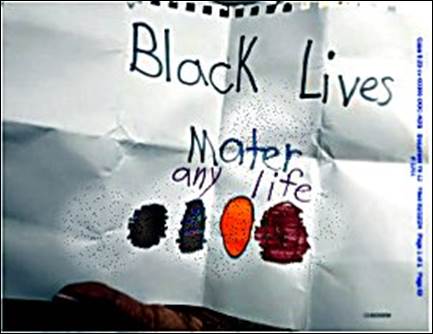
The Ninth U.S. Circuit Court of Appeals held yesterday that a District Court judge erred in granting summary judgment in favor of an Orange County elementary school principal in an action accusing the school of forcing a first grader to sit out recess after she handed a Black classmate a drawing with the words “Black Lives Mater any life” following a reading of a story about Martin Luther King Jr.
Declaring that the student’s young age is a relevant factor in analyzing whether the response was within constitutional bounds, the court said that District Court Judge David O. Carter of the Central District of California erred by giving the students’ immaturity too much weight in his determination that the drawing “is not protected by the First Amendment.”
Yesterday’s per curiam opinion, signed by Circuit Judges Consuelo M. Callahan, Roopali H. Desai, and Ana de Alba, declares:
“This case presents an important issue: to what extent is elementary students’ speech protected by the First Amendment? Applying the criteria set forth in [the 1969 U.S. Supreme Court decision in] Tinker v. Des Moines Independent Community School District,…we hold that elementary students’ speech is protected by the First Amendment, the age of the students is a relevant factor…, and schools may restrict students’ speech only when the restriction is reasonably necessary to protect the safety and well-being of its students. Because the…analysis raises genuine issues of material fact, we vacate the grant of summary judgment and remand.”
Complaint Filed
The question arose after Chelsea Boyle filed a complaint, on behalf of her child “B.B.,” against the Capistrano Unified School District, Viejo Elementary School Principal Jesus Becerra, and others, in February 2023. In the operative complaint, she asserted claims under 42 U.S.C. §1983 as well as state law causes of action.
According to Boyle, in March 2021, when B.B. was a first-grade student at Viejo, her teacher read the class a story about Martin Luther King Jr., which ended with a reference to “black lives matter.” B.B. said that she “felt bad” after hearing about the unequal treatment of Black people leading up to the Civil Rights Movement of the 1950s and 1960s.
In response, B.B. drew a picture that she described as showing “all her friends holding hands” and wrote on it the words:
“Black Lives Mater [sic] any life.”
B.B. then gave the paper to her classmate, M.C., who is Black. M.C. thanked B.B. and took the drawing home, where her mother found it.
M.C.’s mother emailed Becerra, expressing concerns over the use of the phrase “any life” and saying:
“My husband and I will not tolerate any more messages given to our daughter because of her skin color.”
Boyle claimed that Becerra took B.B. aside the following day and told her that the drawing was “not appropriate,” that she was not allowed to give artwork to other students, and that she should apologize to M.C. B.B. said she apologized to her classmate and was barred from recess for two weeks.
Summary Judgment
After hearing about the incident from other parents nearly a year later, Boyle filed a complaint with the school district before filing legal action. Following multiple motions to dismiss, the defendants moved for summary judgment on the sole remaining First Amendment claim. In Feb. 2024, Carter granted the request, saying:
“Giving great weight to the fact that the students involved were in first grade, the Court concludes that the Drawing is not protected by the First Amendment….
“Undoubtedly, B.B.’s intentions were innocent….But Tinker….examines the effects of speech on the learning environment and other students, giving deference to school officials’ assessments about what speech is acceptable in an educational setting….Such deference…is especially appropriate today, where, increasingly, what is harmful or innocent speech is in the eye of the beholder. Teachers are far better equipped than federal courts at identifying when speech crosses the line from harmless schoolyard banter to impermissible harassment.”
After judgment was entered in favor of all defendants in March 2024, B.B. appealed the order granting summary judgment to Becerra on her First Amendment claims.
Tinker Analysis
In Tinker, the high court affirmed that students do not “shed their constitutional rights to freedom of speech or expression at the schoolhouse gate” but that an educational institution may regulate speech if it materially disrupts classwork or invades the rights of classmates. If either of those circumstances is present, courts are directed to balance the school’s interest in protecting pupils against the targeted child’s right to freedom of expression.
The panel pointed out that, following Tinker, the Ninth Circuit has found that the age of the student at issue is relevant to the analysis, and that grade schools may exercise a greater degree of control over speech than other institutions because of the vulnerability of elementary-aged children. The judges wrote:
“Although we have not had occasion to apply the Tinker balancing test to elementary students, our prior opinions have recognized both that students have First Amendment rights and that the students’ ages are relevant to evaluating whether a school’s actions were reasonably designed to protect the safety and well-being of its students.”
Citing the court’s 2006 decision in Harper v. Poway Unified School District, which addressed a request for a preliminary injunction barring a high school from precluding a student from wearing a shirt that displayed derogatory remarks about homosexuals and held that “verbal assaults on the basis of a core…characteristic such as race…or sexual orientation” interfere with other students’ “right to be free from such attacks while on school campuses.”
Acknowledging that “Harper was vacated as moot” by the U.S. Supreme Court in 2007 after final judgment was entered in the District Court dismissing the petitioner’s claims for injunctive relief, the panel declared that “we find its reasoning sound” and opined:
“[S]chools may regulate student speech under Tinker’s second prong when it involves ‘derogatory and injurious remarks directed at students’ minority status such as race, religion, and sexual orientation.’ ”
Students’ Ages
Continuing, the panel added:
“Of course, the students’ ages affect what is derogatory or injurious. Certain speech may be merely negative or controversial to high schoolers, but may constitute derogatory and injurious remarks against elementary students given their greater vulnerability.”
Noting that the school has the burden of showing that the actions taken were reasonably undertaken to protect the safety and well-being of its students, the court turned to the question of whether Becerra was entitled to summary judgment. Applying the balancing test, the jurists remarked:
“The students’ very young ages gave the school broader discretion, but it does not relieve the school and Becerra from meeting their burden of showing that their actions were reasonably undertaken to protect the safety and well-being of the school’s students. Tinker remains a ‘demanding standard,’ and schools must prove that they meet it….The district court erred to the extent that it relied on the students’ ages as the dispositive factor because genuine issues of material fact exist as to the reasons for restricting B.B.’s First Amendment rights and the extent of the restrictions.”
Pointing out that the parties dispute whether B.B. was actually forced to sit out recess after making the drawing and whether the artwork communicated a denigrating message that required a reprimand, the panel concluded that “B.B. has raised genuine disputes of material fact, and [the defendant] is not entitled to summary judgment.”
The case is B.B. v. Capistrano Unified School District, 24-1770.
Copyright 2026, Metropolitan News Company