Friday, February 6, 2026
Page 3
Ninth Circuit:
Lawsuit by ‘Hatchet-Wielding Hitchhiker’ Is Partially Revived
Opinion Says Defamation Claim, by Subject of Netflix Documentary About Viral Rise to Fame After Striking Man Who Gave Him Ride, Survives Against Defendant Who Told Film Crew That Plaintiff Admitted Giving Driver Laced Joint
By Kimber Cooley, associate editor
|
|
|
Caleb “Kai” McGillvary plaintiff |
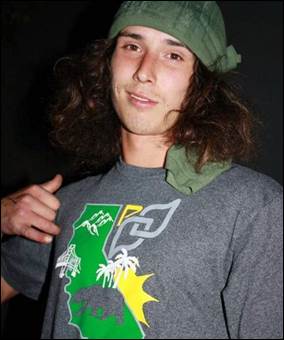
The Ninth U.S. Circuit Court of Appeals yesterday partially revived a lawsuit filed by the subject of a 2023 Netflix Inc. documentary entitled “The Hatchet Wielding Hitchhiker” over claims that interview subjects defamed him in speaking to the filmmakers about the circumstances surrounding a 2013 incident in which he attacked a driver with an axe who purportedly assaulted two passersby after picking up the plaintiff from the side of the road in Fresno.
Yesterday’s decision came by way of a memorandum opinion, authored by Circuit Judges Michelle T. Friedland, Daniel P. Collins, and Senior Circuit Judge Mary M. Schroeder, largely affirming the dismissal with prejudice of the plaintiff’s second amended complaint by District Court Judge Josephine Staton of the Central District of California.
However, the panel revived a single claim against one of the interviewees in the documentary, finding the plaintiff’s allegations that the defendant lied to the crew were sufficient to overcome the heightened standards applicable to statements about limited-public figures.
According to the plaintiff, Caleb “Kai” McGillvary, he was picked up as a hitchhiker in February 2013 by a driver named Jett McBride, who later allegedly crashed his car into a utility worker and assaulted a good Samaritan who tried to intervene. McGillvary later admitted to repeatedly striking McBride in the back of the head with a hatchet that he had hidden inside his backpack in an attempt to subdue the attack.
McGillvary, who was a 25-year-old Canadian transient at the time, recounted the incident for local news outlet KMPH Fox 26, describing the blows as “smash, smash, suh-mash.” After the interview went viral online, the plaintiff appeared on Jimmy Kimmel Live! and was invited to sing and play guitar at the Fresno music venue, Fulton 55; he was cleared of any wrongdoing relating to the incident.
Murder Charges
A few months later, McGillvary was arrested on murder charges relating to the death of New Jersey attorney Joseph Galfy. He was sentenced to 57 years in prison in 2019 after a New Jersey jury found him guilty of killing the 73-year-old victim who had allegedly picked him up in New York.
After the murder trial, one of Fulton 55’s employees, Gabriel Sanchez, agreed to be interviewed by the documentary crew and, according to McGillvary, falsely told the filmmakers that the hitchhiker had admitted to supplying drugs to McBride before the driver attacked the passersby and that the driver had raped him. The documentary aired on Jan. 10, 2023.
In February 2023, McGillvary filed a complaint against, among others, Netflix, Bunim-Murray Productions, and various parties that were interviewed in making the show, including Sanchez and Fresno Police Department employee Jeff Striker.
Acting on his own behalf from prison, he asserted, in the operative complaint, state-law defamation and federal copyright infringement claims, as well as other causes of action relating to the show and the news interviews that led to his rise to fame.
In July 2024, Staton granted Netflix’s Anti-SLAPP motion and dismissed the remaining claims for failure to state a claim but granted leave to amend as to certain causes of action. On Oct. 10, 2024, judgment dismissing the action with prejudice was entered in response to a request by the plaintiff.
Generous Construction
On appeal, McGillvary asserted that the court failed to generously construe his claims in light of his pro se status. Rejecting this contention, Friedland, Collins, and Schroeder said:
“In a detailed and thorough 33-page order, the district court carefully addressed each of McGillvary’s…claims and repeatedly noted that he was proceeding in forma pauperis. Moreover, McGillvary makes no showing that an even more liberal construction of his complaint would have affected the district court’s ruling on any of his claims.”
He specifically challenged the dismissal of two defamation claims, one against Sanchez and the other asserted against Fresno Police Sergeant Jeff Stricker for statements that aired as part of the documentary, including ones indicating that Striker believed that McGillvary had “some culpability” for what happened in Fresno and that McBride had told the investigator that the plaintiff had encouraged him to run over the utility worker.
Finding that Striker had issued “a non-actionable opinion” relating to McGillvary’s culpability, the jurists addressed the police officer’s other commentary. They noted that “[b]ecause McGillvary is a limited-public figure with respect to the 2013 Fresno incident,” he must show that any false statements were made with “actual malice” or a “reckless disregard of their truth.”
Applying that standard, they remarked:
“The complaint acknowledges that Stricker was recounting statements made by McBride during Stricker’s interview with him,…but McGillvary nonetheless contends that Stricker…repeated McBride’s statements with reckless disregard of their truth. McGillvary suggests that (1) if Stricker…personally believed that McGillvary had told McBride to drive into Neely, [he] would have said so at McBride’s arraignment or at trial, and that (2) because Stricker had heard McGillvary testify…, he had ‘grave reason to doubt’ statements…that conflicted with McGillvary’s testimony. The inferences that McGillvary seeks to draw from these limited allegations…are too speculative….”
Defamation Claim
Addressing the claim against Sanchez, the judges opined:
“[W]e conclude that the district court erred in holding that McGillvary failed to plead ‘any facts supporting actual malice.’…The complaint squarely alleges that McGillvary ‘never, in fact, said any such thing’ to Sanchez. Taking that well-pleaded allegation as true, and drawing all reasonable inferences in McGillvary’s favor, we conclude that the complaint raises a plausible inference that Sanchez simply fabricated the statements….And because wholesale fabrication of a self-defamatory quotation would be sufficient to establish actual malice,…we conclude that the district court erred in dismissing the defamation claim against Sanchez….”
Saying that the plaintiff “challenges the district court’s denial, as moot, of his ‘contingent’ motion to amend his complaint to invoke diversity jurisdiction in the event that his sole surviving claims were state law claims,” they added:
“McGillvary argues that he should be allowed to amend his complaint so as ‘to cure jurisdictional defects’ with respect to his defamation claim against Sanchez. The district court, having dismissed that particular claim with prejudice, did not have the specific issue of such an amendment before it when it denied McGillvary’s contingent motion. Given our reversal as to the defamation claim against Sanchez, we leave it to the district court to consider the amendment issue in the first instance on remand, and we express no view on it.”
The case is McGillvary v. Bunim Murray Productions LLC, 24-6944.
Copyright 2026, Metropolitan News Company