Monday, August 3, 2026
Page 1
Ninth Circuit Rejects Writer’s Copyright Claims Over Paramount Pictures’ ‘Infinite’ Film
Opinion Says Plaintiff Failed to Adequately Allege That Studio Infringed His Novel About Man With Reincarnation Ability That He Says He Shared With Staff While Working on Film Set
By a MetNews Staff Writer
|
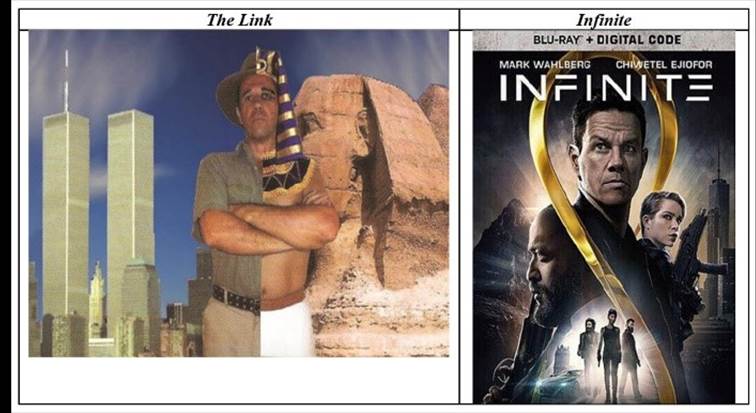
The Ninth U.S. Circuit Court of Appeals has held that a District Court judge rightly dismissed the claims of a novelist who asserted that Paramount Pictures Corporation’s 2021 movie “Infinite” infringed the copyright of his 2002 novel “The Link” based on what he alleged were substantial similarities between characters, each of which allegedly uses a power of reincarnation to fight a “genocidal villain.”
Pointing out that an infringement claim under the Copyright Act, based on 17 U.S.C. §501, requires proof that the defendant had access to the plaintiff’s protected work, the court declared, in Thursday’s memorandum decision signed by Circuit Judge Kenneth K. Lee, Patrick J. Bumatay, and Gabriel P. Sanchez, that the writer’s bare allegation that he had given away copies of his book to Paramount staff while working on a 2011 production was insufficient.
They also rejected his theories that access could be shown from the fact that his novel was at one point available on Amazon.com, and had been offered for sale at the now-defunct Borders bookstore chain, or based on an alleged overlap between the stories, saying that the plaintiff failed to meet the “high bar” of similarity required to establish infringement. Asserting that his work was infringed was Baynardo Sandy, who filed a complaint against the production giant in 2024, alleging a claim under §501 and seeking monetary damages as well as declaratory and injunctive relief. In the pleading, he said that he “has been working in the film industry since 1995” and “gave away copies of The Link” to Paramount staff while working “as a property assistant” on “Cirque Du Soleil: Worlds Away 3D” in 2011.
He further claimed that “Infinite’s DVD-cover was strikingly similar to Plaintiff’s bookcover for also exhibiting the World Trade Center Complex (‘W.T.C.’), even though the W.T.C. was not even part of the plot in Infinite” and said that the mountain depicted on the case resembles a pyramid, pointing out that the jacket to his novel also depicted an artifact from ancient Egypt, the Great Sphinx of Giza.
Sandy added that both works feature an unmarried, childless, adopted hero that is suddenly able to recall past lives and remarked that both plots involve “reincarnations in Europe” during the 1750s. He acknowledged that his book contains spiritual themes absent from the film but claimed that, “[o]nce released, Plaintiff recognized ‘Infinite,’ as a secular version of his novel” and that “removing the…spiritual plot” would avoid “a religious boycott.”
In December 2024, District Court Judge R. Gary Klausner of the Central District of California granted Paramount’s motion to dismiss, with prejudice, rejecting the plaintiff’s theories of access and saying:
“While Plaintiff lists countless alleged similarities, it appears that most, if not all, are so general as to not qualify as protectable expression.”
Inadequate Theories
Lee, Bumatay, and Sanchez agreed with Klausner that the plaintiff “did not adequately plead access under any of the following theories: (1) widespread dissemination, (2) a chain of events, or (3) striking similarity between the works.” They opined:
“First, Sandy did not sufficiently allege that The Link was widely disseminated….Sandy alleges that his novel was widely disseminated because it is ‘accessible online as a 5-Star at Amazon.com for 15 years up to Infinite’s public release in 2021’ and was sold at Borders Bookstore. This is insufficient, because the mere posting of a work on the internet or the sale of an unknown number of copies at a bookstore does not show more than a ‘bare possibility’ that his work was accessed, which does not constitute ‘widespread dissemination.’ ”
As to distribution, they noted that, “for a plaintiff to establish access on a chain of events theory, he must show that there is a ‘reasonabl[e] possib[ility] that the paths of the infringer and the infringed work crossed’ ” and commented:
“Sandy alleges that he gave multiple copies of his book to Paramount staff when he worked on the set of a Cirque du Soleil production….Sandy does not allege exactly how many copies were received, who they were given to, and whether there were copies received by Paramount staff that worked on Infinite. Sandy’s allegations thus amount to ‘[b]are corporate receipt,’ which is not enough to plausibly allege access.”
Substantial Similarity
The jurists continued:
“The Link and Infinite do not meet the high bar of ‘strikingly similar,’ let alone substantially similar. In broad strokes, Infinite is about a man who is wrongly diagnosed with schizophrenia and then discovers that he is one of 500 ‘Infinites’ who reincarnate, and he recovers memories from his past lives to ultimately save the world from destruction. The Link…is about an astrologer and novelist who reincarnates at various points throughout history, and who ultimately achieves his goal of finding the reincarnated Jesus Christ….The similarities that Sandy points to…are largely ‘general plot ideas’ that are not protected by copyright law.”
They rejected the plaintiff’s argument that the court should ignore the religious theme from his novel, saying:
“[T]he religious theme in The Link is its main, overarching theme, and Sandy does not cite to any precedent suggesting that works must be altered in order to properly compare them.”
Addressing a claim for a relief from judgment under Rule 60(b) based on allegations that Klauser was required to disqualify himself based on his ownership of stock in Warner Brothers Entertainment Inc., the judges said:
“Relief under Rule 60(b) is reserved for ‘extraordinary circumstances.’…The district judge’s ownership of stock in Warner Brothers does not warrant relief from judgment. At the time of the proceedings, the proposed merger between Warner Brothers and Paramount was merely a possibility, and therefore would not impact the district judge’s partiality. Thus, any alleged procedural defects cannot be attributed to bias and do not warrant relief from judgment.”
In a footnote, they added: “Sandy does not object to the district court’s not granting him leave to amend after the first motion to dismiss. In any case, we determine no abuse of discretion in the district court’s decision because his claims would be futile based on the allegations.”
The case is Sandy v. Paramount Pictures Corporation, 25-1287.
Paramount attributes the story behind its film to “The Reincarnationist Papers,” a novel by D. Eric Maikranz that was published in 2009. In his complaint, Sandy also asserted that that “Maikranz’s plot-idea was also stolen from The Link.”
Copyright 2026, Metropolitan News Company