Monday, May 18, 2026
Page 1
Ninth Circuit: Putative Consumer Class Action Over ‘Naturally Flavored’ Label Is Revived
Opinion Rejects View That Licorice Package Ingredient List Sufficiently Discloses Inclusion of Artificial Components, Says Reasonable Buyer Is Not Expected to Be ‘Chemist’
By Kimber Cooley, associate editor
|
|
|
Depicted above are two screenshots from the plaintiff’s operative complaint purportedly depicting the packaging of Wiley Wallaby Very Berry licorice. The Ninth U.S. Court of Appeals on Friday reinstated putative class claims against KLN Enterprises, the maker of the product, based on allegations that notations on the front and back labels indicating that the snacks are “naturally flavored” and “free from artificial” flavors are deceptive. |
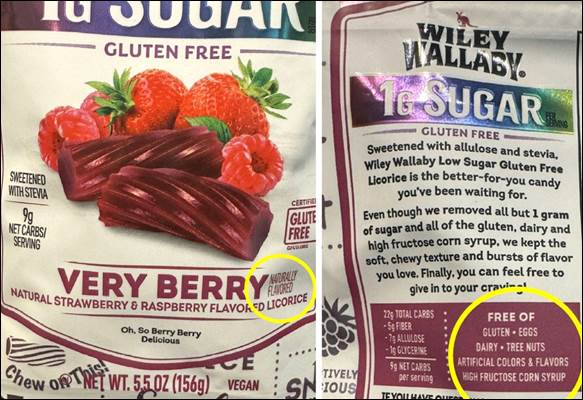
The Ninth U.S. Circuit Court of Appeals held Friday that a District Court judge wrongly dismissed, for failure to state a claim, a putative class action alleging that the packaging on certain Wiley Wallaby licorice snacks includes the false representation that the candy is “naturally flavored” and free from “artificial” flavors when the product actually contains a petroleum-based ingredient in asserted violation of California consumer protection laws.
Circuit Judge Eric C. Tung, writing for the court, said that the jurist erred in finding that the plaintiff, who alleged that an independent laboratory confirmed the presence of the artificial ingredient, failed to meet the heightened pleading requirements for fraud claims under Federal Rule of Civil Procedure 9(b) and that the public is not likely to be deceived because the ingredient list is plainly visible. Tung wrote:
“[KLN Enterprises Inc.] represented to consumers that its [Wiley Wallaby licorice snacks] contained no artificial flavors. The plaintiff bought the product believing the representation to be true….Laboratory testing revealed that the product’s flavoring was not naturally occurring but made from an artificial petroleum substrate. At least this is what the plaintiff alleged (albeit with more detail) in his complaint. The district court concluded, however, that the plaintiff failed to state a claim and dismissed the complaint with prejudice. We disagree and reverse.”
Putative Class Complaint
Appealing the dismissal was Mark Trammell, a San Diego resident who filed a putative class complaint against the Minnesota-based KLN Enterprises in October 2023. The operative complaint asserts a claim under the California Consumer Legal Remedies Act, found at Civil Code §1750 et seq., among other state-law causes of action.
In the pleading, Trammell alleged that the front label of the snacks he purchased indicates that the products are “Naturally Flavored,” and the back of the packaging confirms that the licorice is “Free of” “Artificial Colors & Flavors.” Saying that “the Products contain an ingredient known as ‘malic acid’ ” as a flavor component, he asserted:
“There is a synthetic or artificial version of malic acid derived from a petroleum substrate and other synthetic components. It is commonly referred to as DL malic acid….DL malic acid is manufactured in petrochemical plants from benzene or butane—components of gasoline and lighter fluid, respectively—through a series of chemical reactions, some of which involve highly toxic chemical precursors and byproducts.”
Trammell cited results of a June 28, 2023 analysis of the product by Krueger Food Laboratories Inc., which he said revealed that the artificial form of the flavoring was present in the snacks.
Motion to Dismiss
KLN Enterprises moved to dismiss the pleading for failure to state a claim upon which relief may be granted under Federal Rule of Civil Procedure 12(b)(6), arguing, in part, that “[t]he wallaby in the room is that this Product is a mass-produced, shelf-stable, bright red candy” and that no reasonable consumer would be believe that such a snack is “free of artificial flavors,” especially in light of the inclusion of the “FDA mandated ingredient list” on the back label.
Senior District Court Judge Marilyn L. Huff of the Southern District of California granted the defendant’s motion on Sept. 12, 2024, finding that Trammell had failed to “plead with sufficient particularity that the malic acid used in the product is artificial” and that challenged labels were not deceptive. She opined:
“Defendant discloses both natural and artificial ingredients in plain text on the product’s back label….Moreover, nowhere on the front or back label does it state that the product is ‘all natural,’ ‘100% natural,’ or ‘free of artificial ingredients.’…Accordingly, nothing about this product…would lead a reasonable consumer to conclude that Wiley Wallaby Very Berry Licorice is free of artificial ingredients when the product labels make no [such] affirmative representations….”
The complaint was dismissed without leave to amend, and judgment was entered the following day. Friday’s opinion, joined in by Circuit Judges Kim McLane Wardlaw and Ana de Alba, reverses the judgment.
Plausible Claim
Addressing whether the complaint alleged a plausible claim of consumer fraud, Tung said:
“Trammell plausibly pleaded that a reasonable consumer is likely to be deceived by a product that claims to be free of artificial flavors when that claim is (allegedly) not true. Pleading the presence of an artificial flavor in the Product— namely, artificial DL malic acid, as disclosed by laboratory tests…—is enough to satisfy the reasonable-consumer standard on a motion to dismiss.”
Commenting that “[t]he arguments against this conclusion lack merit,” he opined:
“[T]he district court does not find the back label deceiving because, in its view, ‘Defendant discloses both natural and artificial ingredients in plain text on the product’s back label.’…That argument fails. The ingredients list on the back label does not disclose, on its face, which of the ingredients are artificial….Some ingredients, like ‘malic acid,’ may come in two forms—natural or artificial. But the list does not say which it is.”
Tung continued:
A reasonable consumer, not being a chemist, is not in a position to make that assessment when buying the Product….What a reasonable consumer can understand is the Product’s representation that there are no artificial flavors. When that clear representation is placed next to an ingredients list—a list that does not make apparent (1) which ingredients are flavors and (2) which of those ingredients are artificial—a reasonable consumer could plausibly be (mis)led into believing that the Product does not contain artificial flavors. If anything, the ingredients list here—which does include an ingredient called ‘natural flavor’—reinforces the Product’s free-of artificial-flavors statement.”
Absent Assertions
As to Huff’s point that the packaging does not include assertions that the product is “all natural,” he responded:
“That point is true but irrelevant. Trammell’s claim is not that the product falsely purports to be ‘all natural,’ ‘100% natural,’ or ‘free of artificial ingredients.’ Instead, Trammell claims that the product falsely represents to be free of artificial flavors, and he has alleged plausible facts to support it.”
Rejecting the view that the brightly-colored nature of the candy makes the inclusion of artificial ingredients obvious to any reasonable consumer, he wrote:
“Colors and stability may go to the artificiality of the coloring and preservative; they do not necessarily bear on the artificiality of the flavors.”
Saying that “[t]he district court erroneously held that Trammell’s complaint failed to satisfy” the heightened pleading requirements of Federal Rule of Civil Procedure 9(b), which provides that “a party must state with particularity the circumstances constituting fraud or mistake,” Tung remarked:
“The allegations set out: the ‘who’ of the fraud (KLN); the ‘what’ (KLN’s representation that its Product is free of artificial colors and flavors); the ‘when’ (around the time Trammell purchased the Product in May 2023); the ‘where’ (the purchase occurred at a Target in Encinitas, California); and the ‘how’ (the statements on the Product’s label…). Trammell also explained ‘what is false about the statement’ and ‘why it is false’….”
Adding that “Trammell alleged the specific laboratory…that performed the testing…; he provided a date of the testing…; he explained the qualifications of the laboratory…; and he discussed the laboratory’s ‘industry standard’ methodology,” he distinguished “three trial-level decisions” dealing with allegations of false natural-ingredient labels by companies selling products containing malic acid cited by Huff that he said are “non-precedential and inapposite.”
The case is Trammell v. KLN Enterprises, 24-6097.
Copyright 2026, Metropolitan News Company