Monday, June 1, 2026
Page 1
Court of Appeal:
‘Black Lives Matter’ Mural Wasn’t Workplace Harassment
Justices Reject Contention That Depiction of State-Trooper Slayer, Along With Symbol of Black Panthers, on City-Commissioned Artwork Painted on Public Street Created Hostile Work Environment for Police Officers
By a MetNews Staff Writer
|
|
|
Depicted is a mural painted on the street in front of City Hall in Palo Alto. The Sixth District Court of Appeal on Thursday affirmed a summary judgment in favor of the city, finding that six police officers cannot show workplace harassment based on the images in the last two letters of the words, “BLACK LIVES MATTER.” |
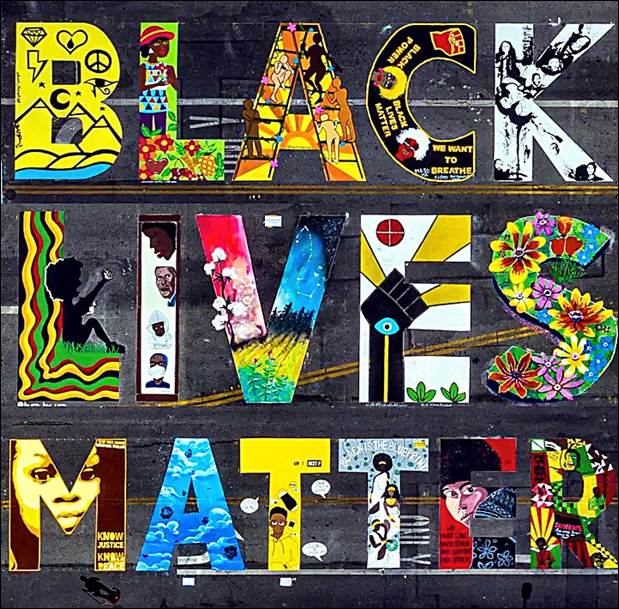
The Sixth District Court of Appeal has affirmed a summary judgment in favor of the City of Palo Alto in an action brought by six police officers who claim that the municipality created a hostile work environment by commissioning a mural and placing it on temporary display, with the artwork including a likeness of Assata Shakur who was convicted of the 1973 first-degree murder of a New Jersey state trooper.
Shakur made a prison break in 1979 and the FBI and the Office of New Jersey Attorney General each offered a $1 million reward for information leading to her capture—which never occurred; she died last year in Cuba.
In an unpublished opinion, filed Thursday, Justice Cynthia C. Lie declared that “the city demonstrated plaintiffs’ inability to establish a claim for workplace harassment,” rejecting the contention that the effect of the mural could have been so unsettling as to constitute an adverse circumstance of employment.
The mural, which was unveiled on June 30, 2020 and removed on Nov. 10, 2020, was painted on the street in front of City Hall. Aside from its depiction of Shakur, it contained a black cat, whether relating to the “New Black Panthers Party,” a radical hate group—as the plaintiffs perceived it to be—or, as the trial judge regarded it, harking to the logo of the Black Panther Party of the 1960s, a militant, socialist Black Power organization.
The mural was comprised of the words, “BLACK LIVES MATTER,” with an image of Shakur embedded in the “E” and the cat appearing inside the “R.” The mural was authorized by the city in the aftermath of the police killing of George Floyd in Minnesota which sparked demonstrations nationwide.
Trial Court Decision
Brought under the Fair Employment and Housing Act (“FEHA”), the plaintiffs, non-Blacks of various ethnicities, asserted that the mural was repugnant to them and distracted them from their work. In granting summary judgment, Santa Clara Superior Court Judge Evette Pennypacker found a lack of offensiveness, on an objective level.
She said there is “no evidence that any aspect of the Mural, much less the letters ‘E’ or ‘R,’ was directed to any particular person, including any particular non-African American police officer,” adding:
“The circumstances here are that the Mural, developed for the entire community, contained a logo from the original Black Panther Party in one letter, a vague reference to Assata Shakur coupled with the statement ‘we must love each other and support each other’ in another letter, and 13 other large apparently non-objectionable letters, and Plaintiffs, non-African American Palo Alto police officers, came into contact with the Mural in a public place as they walked in and out of their precinct sometimes in and sometimes out of uniform, licensed to carry and likely at least sometimes actually carrying a firearm. Looking, as we must, at all of these circumstances, Plaintiffs cannot state a claim for workplace harassment as a matter of law….”
Appellants’ Contentions
The officers argued on appeal:
“In refusing to remove the harassing and discriminatory iconography, the City approved the Mural’s harassing and discriminatory iconography as a means to appease one racial group (African Americans) at the expense of all others….Not only did defendants allow the harassing and discriminatory iconography to exist in the workplace, but defendants also sanctioned, approved, encouraged, and paid for it.”
They contended:
“Here, there is clearly a triable issue of fact as to whether a reasonable non-African American police officer in Plaintiffs’ circumstances would have considered the depiction of Assata Shakur, a convicted murderer of a Caucasian police officer and fugitive, to create a hostile, intimidating, offensive, oppressive, or abusive work environment despite the fact that the words ‘we must love each other and support each other,’ appeared alongside the depiction of Shakur….It is for the jury to decide, based on the ‘totality the circumstances’—including the addition of the ‘love each other’ language, whether a reasonable non-African police officer may perceive the depiction of a race-based cop killer as harassing.”
The same applies to the logo, they maintained.
Lie’s Opinion
Lie wrote:
“Even if we assume that, like plaintiffs, a reasonable police officer sharing plaintiffs’ shared racial classification might discern a racist message in the two challenged images, the city met its burden of negating plaintiffs’ claims that the images were unlawful harassment.”
Quoting language from the California Supreme Court’s 2024 opinion in Bailey v. San Francisco District Attorney’s Office, the jurist said:
“As a matter of law, the ambiguity of the purported racist content plaintiffs would attribute to each image in the mural’s context means that what plaintiffs find harassing was not ‘sufficiently severe or pervasive to alter the conditions of [plaintiffs’] employment and create an abusive work environment.’ ”
Different local artists painted various portions of the mural. The city insisted that in approving a proposed design for the letter “E,” it had no idea who Shakur was.
The artist who crafted the prototype defended her use of a likeness of Shakur by saying that the woman was a “political refugee” who symbolized the quest to spare Blacks from “racial capitalism and white supremacy.”
No Racial Harassment
Rejecting the plaintiffs’ claim of harassment, Lie said:
“[C]onsidering the undisputed totality of the circumstances—including the facial message of the mural extolling inclusivity, the ambiguity of the artwork, the mural’s location in a public space where it can be viewed by all members of the public, the city’s explanation disavowing any harassing interpretation and invoking the subjective nature of the artwork, the artist’s explanation for including Shakur in the ‘E,’ the otherwise unobjectionable nature of the mural, the absence of any other message or artwork from or authorized by the city that could be interpreted as racially harassing plaintiffs—the conduct complained of here constitutes neither severe nor pervasive harassment because of race.”
The case is Ferreira v. City of Palo Alto, H052577.
Copyright 2026, Metropolitan News Company