Tuesday, August 4, 2026
Page 1
Ninth Circuit:
Former Supervisor Ridley-Thomas’ Bribery Conviction Stands
Opinion Says While Ex-Politician’s Funneling of Funds to USC, Which Then Sent Same Amount to Charity Employing His Son, May Not Be ‘Usual’ Scheme, He Received Something He Considered Valuable
By Kimber Cooley, associate editor
|
|
|
MARK RIDLEY-THOMAS former county supervisor |
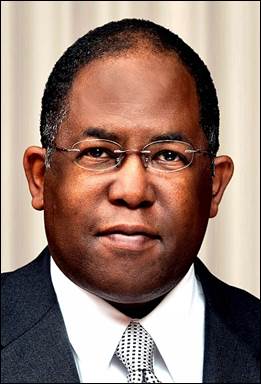
The Ninth U.S. Circuit Court of Appeals yesterday affirmed the bribery-related convictions of disgraced ex-Los Angeles County Supervisor Mark Ridley-Thomas, who had also previously served as a city councilmember and as chairman of the State Assembly Democratic Caucus, rejecting his assertion that his payment of $100,000 in campaign funds to USC, which then donated the same amount to a charity founded by his son, did not violate federal law.
In yesterday’s per curiam opinion, signed by Circuit Judges Johnnie B. Rawlinson, Morgan B. Christen, and Anthony D. Johnstone, the court acknowledged that the transfer was “admittedly not the usual bribery scheme involving the transfer of money to a public official.” But, they wrote, “the transfer of $100,000 from Mark Ridley-Thomas to USC to [California] United Ways” for his son Sebastian Ridley-Thomas’ benefit “constitutes a ‘thing of value’ under our precedent.”
The opinion continues:
“The Government’s evidence established that Ridley-Thomas subjectively valued the ability to transfer $100,000 from his campaign fund to United Ways, specifically to a program that would benefit Sebastian by providing him with employment after he resigned from the legislature. The evidence showed that Ridley-Thomas was aware of the ethics inquiry….”
They continued:
“Ridley Thomas argues strenuously that he broke no campaign finance laws by making this payment, and that because he could have made the donation directly, the funneling service provided by USC cannot constitute a ‘thing of value.’ But this argument overlooks the…evidence showing that [the defendant] attempted to send a payment directly from his campaign fund to another non-profit where Sebastian hoped to be employed, and the funds were returned because the…director was concerned about ‘…being seen as doing special favors for special people.’ ”
Benefits for Son
According to prosecutors, Mark Ridley-Thomas, who served on the Board of Supervisors from 2008-20, used his position to secure a “landing spot” for his son, Sebastian Ridley-Thomas, by conspiring with Marilyn Flynn, then-USC’s dean of the School of Social Work, in 2017.
At the time, Sebastian Ridley-Thomas was serving in the state Assembly but was facing two confidential sexual harassment complaints. Flynn, in turn, was allegedly looking to correct a multimillion-dollar budget deficit in her department by securing county contracts to fund expanded telehealth counseling services by university social workers.
Mark Ridley-Thomas had inquired about a position for his son with the African American Civic Engagement Project and donated $100,000 from his campaign committee to the organization in early December 2017. The head of that group returned the funds after Sebastian Ridley-Thomas resigned from the state Assembly later that month.
In January 2018, after Sebastian Ridley-Thomas formed his own non-profit, the Policy, Research & Practice Initiative (“PRPI”), the then-supervisor contacted President and CEO of California United Ways Peter Manzo and secured a sponsorship agreement under which PRPI’s founder would receive a $75,000 salary.
That February, USC offered the younger Ridley-Thomas a faculty appointment at the School of Public Policy and a full-tuition scholarship to pursue graduate studies. About a week later, Flynn emailed Mark Ridley-Thomas seeking several desired amendments to the telehealth contract with the county.
She later told USC Executive Vice Dean John Clapp that “we’re going to get the Telehealth contract” but that she “had to do a little favor to get it.”
Donation to USC
On May 2, 2018, the defendant donated $100,000 from his Committee for a Better L.A. to Flynn’s department, and USC then facilitated the transfer of the same amount to United Way after Flynn represented to colleagues that the charitable group was a vendor. On July 31, 2018, Mark Ridley-Thomas voted in favor of an amended Telehealth contract that included Flynn’s requests.
After a whistleblower raised concerns about the transaction, USC opened an internal investigation that eventually led to the return of the $100,000 and the termination of Sebastian Ridley-Thomas’ teaching position and scholarship.
The school referred the matter to the U.S. Attorney’s Office, which charged Mark Ridley-Thomas and Flynn with conspiracy in violation of 18 U.S.C. §371, bribery under 18 U.S.C. §666, as well as multiple counts of mail and wire fraud in October 2021. In March 2023, a jury found Mark Ridley-Thomas guilty of conspiracy, bribery, and several counts of fraud based on the funneling of the $100,000 to United Way.
On Aug 28, 2023, District Court Judge Dale Fischer of the Central District of California sentenced him to 3 years in prison to be followed by a period of supervised release. Flynn pled guilty in 2022 and was sentenced to three years of probation and ordered to pay a fine of $150,000.
Traditional Schemes
Rawlinson, Christen, and Johnstone rejected the defendant’s assertion that statutes he was convicted of violating only criminalize traditional bribery and kickback schemes. They pointed out that the fraud and bribery laws require the receipt of a “thing of value” but that case law has defined that term broadly to include subjective worth.
The judges wrote:
“Ridley-Thomas contends that the Government’s theory of bribery was predicated on his desire to avoid the nepotistic optics that had hampered his previous attempt to provide $100,000 to [another charity]. Ridley Thomas maintains that ‘perceived reputational benefit’ cannot be a ‘thing of value’…because no…bribery or kickback case has recognized a similar ‘thing of value.’ ”
They responded:
“This argument misstates the Government’s theory….The Government explicitly alleged in the indictment that the transfer of $100,000 was one of the quids in the quid pro quo scheme between Ridley-Thomas and Flynn, and it maintained this argument throughout trial. The district court instructed the jury that ‘a thing of value does not have to be tangible,’….”
Adding that “[n]or is there a requirement that each participant in the scheme personally benefit,” the panel said:
“Ridley-Thomas’s request for Flynn’s assistance occurred while the Telehealth amendment hung in the balance, awaiting approval from the Board of Supervisors. Flynn’s assistance with the $100,000 cash transfer through USC for Sebastian’s benefit was an impermissible string attached to Ridley-Thomas’s support of the Telehealth amendment….[H[is arrangement ‘clouded [Ridley-Thomas’s] judgment in performing his official duties and deprived [Los Angeles County residents] of the honest services of their elected representative.’ ”
As to the requirement in §666 that the “thing of value” be worth at least $5,000, they said:
“[T]he Government provided evidence that the Telehealth amendment exceeded $5,000 because the amendment, maintained funding for the contract at $530,323. The Government’s evidence that the value of the Telehealth amendment is more than $5,000, was sufficient for the jury to conclude that the bribe related to a transaction of more than $5,000.”
The case is U.S. v. Ridley-Thomas, 23-2200.
Mark Ridley-Thomas left the Board of Supervisors in 2020 and, that year, was elected to the Los Angeles City Council, in which he had served from 1991-2002. In 2021, he was suspended as a member of the council, due to corruption allegations, and, following his 2023 conviction, was ousted from his position.
Fischer allowed the former politician to remain out of custody while his appeal was pending.
Copyright 2026, Metropolitan News Company