Tuesday, July 7, 2026
Page 3
Court of Appeal:
Suit Over Book-Jacket Blurb Lionizing Author Was SLAPP
Opinion Says Minimal Merit Was Not Shown in Action Brought Under Consumer-Protection Laws Asserting That Simon & Schuster, Other, Depicted Developer as Man of Integrity When He Actually Has Criminal Record
By a MetNews Staff Writer
|
|
|
Depicted is the cover of a book that prompted a lawsuit by the author’s brother-in-law, claiming that a statement on the inside flap of the jacket impermissibly portrayed the writer as an honest man notwithstanding a prosecution of him for receiving stolen property. The Court of Appeal for this district on Thursday affirmed an order granting an anti-SLAPP motion. |
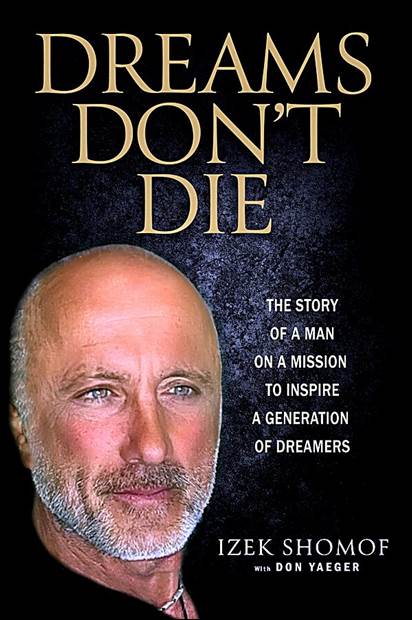
The Court of Appeal for this district has held that a Los Angeles Superior Court judge properly granted an anti-SLAPP motion in a case where a man sued Simon & Schuster, contending the author of memoirs, his brother-in-law, is falsely portrayed on the inside flap of the dust jacket as a virtuous man when, in actuality, he was charged in the 1980s with three felony counts of receiving of stolen property.
He pled guilty, as part of a plea bargain, to a single count which was later reduced to a misdemeanor.
Justice Stephen Goorvitch of Div. Two authored the unpublished opinion, filed Friday. It upholds an order by Judge Bruce G. Iwasaki granting a special motion to strike, under Code of Civil Procedure §425.16, brought by Simon & Schuster, which distributed “Dreams Don’t Die,” and by co-defendant Forefront Books, LLC, publisher of the work.
The book is the memoir of real estate developer Izek Shomof. Plaintiff Patrick Wizmann—whose sister is Shomof’s wife—contends that the author is falsely portrayed by terming him “a man who had every opportunity to take unethical and often-illegal shortcuts but who instead chose the lesser-trod path of honesty and integrity.”
Misleading the Public
He sued under the Unfair Competition Law, Business & Professions Code §17200 et seq., and the False Advertising Law, §17500 et seq. of that code, contending that “the general public is being led to believe that Izek Shomof aka Izek Shlomof is an upstanding businessman based on a false and or misleading depiction of his history.”
Iwasaki ruled that the statement on the dust jacket (also appearing on each of the defendants’ websites) is protected speech, satisfying the first prong of the Shlomi anti-SLAPP statute, and that Wizmann had not met his burden under the second prong of showing minimal merit. He said the statement in question constitutes “an opinion or mere puffery,” elaborating:
“Whether a person chooses the ‘path of honesty and integrity’ is subjective. The sentence is any easy to grasp metaphor, but it is not objective or specific, and cannot be measured or verified....the statement that a person with a flawed past chose a different path is not capable of being proven true or false. ‘Socrates is a man’ is a statement of fact. ‘Socrates is good’ is an opinion.”
Goorvitch’s Opinion
Goorvitch rejected Wizmann’s contention, as Iwasaki had, that the blurb on the dust jacket is unprotected commercial speech. Addressing the second prong, he wrote:
“Here, Wizmann has not demonstrated that the synopsis is false or misleading to a reasonable consumer. The synopsis says that the book shows that Shomof ‘had every opportunity to take unethical and often-illegal shortcuts but...instead chose the lesser-trod path of honesty and integrity.’ Wizmann’s contention that the 1989 conviction renders the synopsis false is unreasonable. One conviction occurring nearly 40 years ago does not render false the synopsis’s summary of the overall trajectory of Shomof s life and career….
“Moreover, the synopsis summarizes the content of the book, promising readers that the book contains the tale of ‘a man who had every opportunity to take unethical and often-illegal shortcuts but who instead chose the lesser-trod path of honesty and integrity.’ Wizmann alleges that Shomof’s prior conviction contradicts that premise, but concedes that the book ‘does not address Shomof s arrest on felony charges[] and subsequent plea[.]’ The synopsis thus truthfully advertises the book.”
Matter of Standing
Goorvitch did not discuss the matter of Wizmann’s standing. In his complaint, the plaintiff said:
“As a result of Defendants’ deceptive advertising. Plaintiff was induced into purchasing the Book….”
Shomof countered in a declaration filed in the trial court:
“[W]hile Wizmann claims the Book Summary misled him and induced him to buy the Book, that is not credible considering that, as my brother-in-law, he has known about the criminal incident that occurred in 1988-89 for many years.”
Wizmann was suing Shomof in connection with a real estate transaction. The author remarked:
“I suspect that Wizmann bought the Book hoping to find something about me that he could somehow use to potentially damage me or my reputation, as appears to be his current mission.”
Telling of the events leading to the prosecution of him, he said that he had purchased a car, not knowing it was stolen, declaring:
“Although I had not intended to do anything wrong, I decided that it would be better to accept responsibility than to fight the case. I pled nolo contendere (no contest) and paid full restitution to the car’s true owner.”
He was placed on three years of probation, a condition of which was to provide community service.
The case is Wizmann v. Simon & Schuster, B339923.
Costa Mesa attorney Jerry Sparks represented Simon & Shuster and David Aronoff and Joshua Bornstein of Aron off the Century City firm of Fox Rothschild acted for Forefront Books, LLC.
Wizmann was in pro per.
Copyright 2026, Metropolitan News Company