Tuesday, August 11, 2026
Page 1
Judge Birnstein to Leave L.A. Superior Court
By a MetNews Staff Writer
|
|
|
Pictured are Los Angeles Superior Court Judge Lauren Weis Birnstein and dog Pepper. Birnstein is readying to leave the bench. |
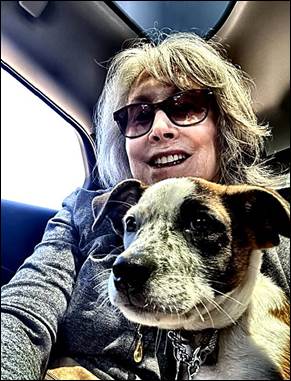
Los Angeles Superior Court Judge Lauren Weis Birnstein’s last day on the bench will be Aug, 19, ending a judicial career that has spanned nearly 24 years.
After using earned vacation days, she will officially retire on Sept. 11.
Birstein was elected to her post in the March 5, 2002 primary, defeating former Superior Court Commissioner Richard Espinoza, Mid-Wilshire attorney Robert Harrison, and West Covina lawyer H. Don Christian. She was, at the time, a deputy district attorney, a position she had held since 1979, after serving a year as a deputy attorney general.
The MetNews endorsed Birnstein (then “Weis”), saying:
“She is skilled, energetic, and committed to the goal of serving with excellence as a Superior Court judge.”
Her law degree is from Loyola.
In her reflections, appearing below, she notes that as a judge, she has had to “keep hiding” her “political leanings”—and says that will be changing once she doffs her robe, relating that she will be speaking out, and protesting.
One area of politics judges need not avoid is judicial elections. Birnstein has publicly asserted that Deputy Public Defender Rhonda Haymon, who is in a run-off for a Los Angeles Superior Court open seat in the Nov. 3 general election, is unfit for a judgeship.
She was named Prosecutor of the Year in 1999 by the Century City Bar Association.
★★★★
A Half Century in the Field of Law
By Lauren Weis Birnstein
(The writer is a judge of the Los Angeles Superior Court.)
|
A |
fter having the privilege of having a wonderful and meaningful career in criminal law spanning just under 24 years in the District Attorney’s Office and close to the same number of years on the bench, it’s time to move on. I had always wanted to be a deputy public defender, but in 1979, that office had a hiring freeze. I joined the D.A.’s Office instead and soon realized I could do more good there because that’s where all the discretion lies. I never prosecuted a case I didn’t believe in.
Until I became a branch head deputy, for the majority of my D.A., career I specialized in sexual assault cases. As a trial attorney, I handled severely traumatized witnesses, multiple victim cases, multiple defendants, and every child molestation case on the Westside of Los Angeles. I think and hope everyone who knew me then would say that I was a tough but fair prosecutor who played by the rules. Although recruited by a prominent defense firm, it was clear that being a prosecutor was the right path for me and I could not see doing anything else no matter the lure. I remember being friends with everyone, including many defense attorneys who allowed me to infiltrate their Aspen criminal law ski seminars in the ’80s and ’90s— trusting that I would do the right thing with the knowledge I gained.
As I pack up my memories, I’ve been reading my old press clippings and have been reminded of how much more creative you can be when you’re performing as an attorney. However, I’ve also tried to use creativity in fashioning the right results and resolutions in my judicial cases.
|
I |
n 2002 I ran for election to become a judge because of changes at the top of the D.A.’s Office. For political reasons, a “gatekeeper” from the D.A.’s Office put the kibosh on my application for a governor’s appointment, so I decided to do it on my own. I won in the primary against three other candidates by getting the endorsements of all newspapers, including the L.A.Times, and visiting a multitude of groups across the political spectrum to win support. My 90 year-old mother-in-law and my dog stood with my husband and me at market and store entrances and in concert lines handing out my post card advertisement on which we printed my bona fides and my “well-qualified” L.A. County Bar rating. It worked and I soon had to buy a black robe.
As part of our training at Judges’ College, we took a personality test. I was told that the introverts made the best judges—probably because it’s easier for them to hold their tongues and listen and maintain appropriate decorum. Sadly, I am an extrovert with a sense of humor. And, without realizing it, for better or worse, I chose as one of my role models Judge Leslie Light having practiced in front of him for some years. Judge Light had been a brilliant D.A. trial attorney, and on the bench he was a tiger and outspoken. If a lawyer missed something, he had no qualms about piping up and sometimes chastising. I admit, I probably got some of my many bad habits from him.
And then there was the exceptional Judge David Fitts (an historical wonder—look him up.) I have never forgotten that he once said not to let the law get in the way. I took that to mean that there’s always a way to do what is right for people—and it’s not always in black and white.
|
A |
t the beginning of my bench career, I remember looking at myself from the outside in to make sure I wasn’t being a second prosecutor on the bench. It took time not to ask myself what each side would think of my ruling or my sentence. I finally reached a place of equilibrium and trusted that as long as I did what I believed was the fair thing and the right thing under the circumstances of the case and the law, I had made the best decision I could. Fortunately, I am thankful that the Court of Appeal has always been so supportive of my reasoning.
I clearly remember the facts of so many of my cases, some horrendous, some harrowing; human beings that act at their worst. Besides those horrible facts, what really impacts me are the acts of humanity that occur. Especially moving and poignant are the unexpected visits I’ve received from defendants who came to thank me for letting them out of prison early on cases that did not require it. Or those that come and tell me I’ve changed their life for the better even though I was tough on them. I also remember all the notes from jurors expressing their appreciation of how hard we work and for the fairness they witness in our courtroom.
It is time for me to move on. I want to smell the roses, take classes in art and music, continue to work out, and travel. I’m not going to sit on assignment because that would mean that I’d have to keep hiding my political leanings. This country is foundering and I want to do what I can to help. I want to volunteer to protect voting rights and our First Amendment rights. I want to protest. I want to get into good trouble, and I hope I don’t get arrested doing any of these. See you on the outside!
Copyright 2026, Metropolitan News Company