Thursday, October 8, 2026
Page 3
L.A. City Council Ban on Two Words Draws Challenge
Complaint Is Filed in U.S. District Court for Central District of California Contending First Amendment Is Violated By Rule Prohibiting Speakers During Public Comment Portion of Meetings From Uttering Specified Vulgarisms
By a MetNews Staff Writer
|
|
|
STACEY SEGARRA-BOHLINGER activist |
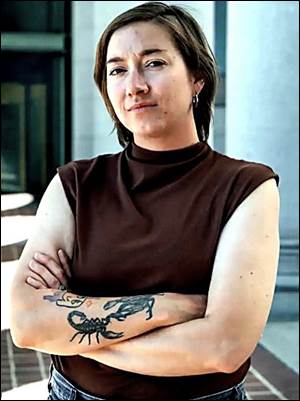
An action has been filed seeking a declaration that a ban on the use of two particular words during the public comment periods of Los Angeles City Council meetings is facially invalid under the First and Fourteenth Amendments, and as applied to the plaintiff who was removed from the legislative body’s chambers and forbidden to return for two days based on her violation of the stricture.
Also sought is an injunction against further enforcement of the policy, a declaration that the city violated the Brown Act—the state’s open-meetings law—in ejecting plaintiff Stacey Segarra-Bohlinger, an award of nominal damages, and an order to pay the activist’s attorney fees.
Bringing Tuesday’s lawsuit in the U.S. District Court for the Central District of California on Segarra-Bohlinger’s behalf were the First Amendment Coalition and the Foundation for Individual Rights and Expression. The complaint, in Segarra-Bohlinger v. City of Los Angeles, 2:26cv11599, declares (with paragraph numbering omitted):
“This case is about whether the First Amendment allows a city government to dictate which words citizens may use when criticizing the city during the public-comment portion of government meetings. It does not.
“That is because the First Amendment protects not only the ideas a speaker wishes to express but also the words the speaker chooses to express those ideas.”
It adds:
“Segarra-Bohlinger brings this lawsuit to protect her right—and the right of all Angelenos—to decide for themselves what to say to their government, and how to say it.”
Rule 7
Under attack in the action is Los Angeles City Council Rule 7, promulgated on July 30 of last year. It reads:
“A public speaker may not use the N-word or C-word, or any variation of either of these words, in a Council or Committee meeting. To avoid ambiguity, the N-word is spelled ‘n’ followed by ‘I’ followed by ‘g’ followed by ‘g’ followed by ‘e’ followed by ‘r.’ The C-word is spelled ‘c’ followed by ‘u’ followed by ‘n’ followed by ‘t.’ Examples of variations of these epithets include, but are not limited to, the words’ plural forms and words created by adding ‘-ish,’ ‘-y’ ‘-ty’ or ‘-ing’ to create related adjectives, adverbs, verbs, or gerundives. Public speakers are prohibited from using the N-word and C-word and their variations even though the speakers would use the words to express a non-offensive, non-vulgar viewpoint.
“The first time a public speaker in a Council or Committee meeting uses the N-word or C-word, or its variation, the staffing City Attorney or presiding officer shall issue a warning to the public speaker that the word and its variations are proscribed and may not be used again in any Council or Committee meeting. If the speaker who received the warning uses the word or its variation again in that or any future Council or Committee meeting, the presiding officer shall reissue the order, note that the officer’s need to stop the meeting to re-issue the order has actually disrupted the meeting, and cut off the speaker’s time to speak for the remainder of that meeting. The disruptive speaker is additionally subject to possible removal and exclusion as other provided in this Rule.”
Ordered to Leave
The City Council ordered the ouster of Segarra-Bohlinger from its Dec. 3, 2025 meeting after she used the word, “cunt”; was reminded of the rule; and employed the term again. She had uttered the same vulgarism the previous Oct. 31 and was admonished after concluding her remarks.
Excluding her in December was wrongful, the complaint avers, because she “did not disrupt the meeting.”
The pleading points to an Aug. 7, 2013 decision by U.S. District Court Judge Dean D. Pregerson of the Central District of California in Dowd v. City of Los Angeles holding that a Los Angeles City Council “rule of decorum” was valid to the extent that it could be interpreted as requiring an “actual disruption” of a meeting for an ejectment to be justified. The judge found that the rule was unconstitutionally applied to plaintiffs David “Zuma Dogg” Saltsburg and Matt Dowd because, according to videotape evidence, their spewing of profanity had not cause a disturbance at a meeting.
As a result of her defiance of the rule, Segarra-Bohlinger was automatically barred from attending meetings of the full City Council or any of its committees that same day or the following day. The complaint asserts:
“[T]he First Amendment does not permit the City to prohibit a member of the public from attending and participating in a future public meeting based on speculation that the person may engage in disruptive conduct at the future meeting.” The rule was enacted pursuant to a March 21, 2025 motion by City Council President Marqueece Harris-Dawson. The motion recites:
“The Los Angeles City Council faces competing duties. It has the legal and moral duties to hear directly from members of the public, consistent with the Ralph M. Brown Act and state constitution. It has the legal and moral duties to provide forums where members of the public are free to participate and exercise their constitutional right to petition their government. And it has the legal and moral duties to protect its staff and members of the public from working and participating in a hostile environment.
“These duties come into conflict when some members of the public in their comments to Council and its Committees use certain offensive epithets. At their worst, these members of the public refer to black members of the public. City staff, and Council members using the ‘N-word’ and to female members of the public, City staff, and Council members using the ‘C-word.’ These two epithets, the N-word and C-word, are also, unfortunately, the most frequently used offensive and injurious epithets at Council and its Committees. Members of the public who choose to use these modes of expression do so not because these epithets are necessary to convey their viewpoints but for the sake of offense and injury itself.”
Tendency to Disrupt
The motion goes on to say:
“Use of these injurious epithets is also disruptive. On many occasions, speakers’ utterances of these two epithets have compelled other members of the public in the Council chamber to shout in objection. At least twice, utterance of the N-word would have triggered not merely verbal but…physical altercations but for the intervention of sergeants-at-arms who prevented fights that were on the cusp of breaking out.”
It continues:
“Besides inciting, or threatening to incite, verbal and even physical altercations, these epithets disrupt Council and Committee meetings by deterring public participation. By creating public spaces many constituents find repellant, these toxifying modes of expression make it intolerable for many members of the public to attend and participate in the meetings. This denies elected officials the benefit of hearing from these constituents, and so subverts the function of the public comment period. It also suppresses the constitutional right of many members of the public to freely petition their government.”
Copyright 2026, Metropolitan News Company