Tuesday, August 25, 2026
Page 1
Screenwriter Alleges TV Series ‘Yellowstone’ Infringed on Her Copyrighted Pilot
By a MetNews Staff Writer
|
|
|
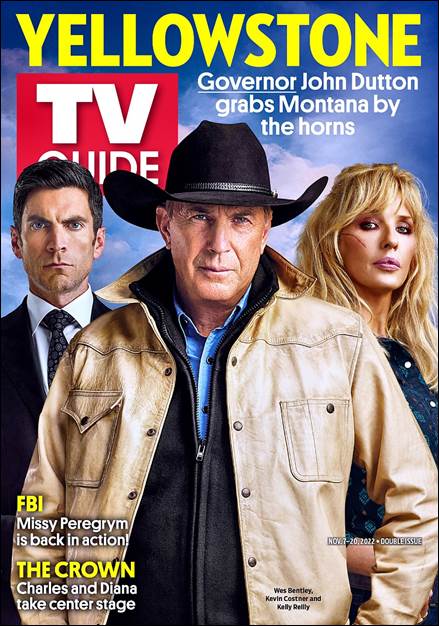
Pictured on the Nov. 7-20, 2022, cover of TV Guide are, from left, “Yellowstone” cast members Wes Bentley, Kevin Costner and Kelly Reilly. A complaint filed in the U.S. District Court for the Central District of California alleges that characters in the TV series are patterned after those in a script authored by plaintiff Lauren J. Salkin. |
The television series “Yellowstone,” which aired on the Paramount Network from 2018-24 and led to spin-offs, infringes on the copyrighted works of a television producer/screenwriter, a complaint filed in the U.S. District Court for the Central District of California alleges.
Friday’s pleading was filed on behalf of Lauren J. Salkin who claims that she, not defendant Taylor Sheridan, originated the premise and characters featured in “Yellowstone.” Sheridan is generally credited as co-creator of the series (with John Linson) and creator of the sequels.
The complaint, drafted by attorney Ashley R. Fickel of the Century City firm of Stinson LLP, alleges:
“Lauren Salkin spent more than a decade developing Sovereign Nation, a dramatic television series centered on tribal governance, casino-driven economic power, and a modern war over land and development. The federal copyright record documents successive registered versions of the project beginning in 2010.”
Proposal Detailed
It says that by late 2016, Salkin had written the script for a pilot, had put together a concise presentation known as a “pitch deck,” and formulated a “show bible” describing characters, settings, and other elements of the proposed series. She “was actively submitting the project for production,” the complaint relates, saying that recipient of the materials included “Sheridan’s representatives.”
A Feb. 1, 2017 rejection letter advised:
“Taylor thanks you very much for your interest. Unfortunately, he’s unavailable for TV projects.”
“Yellowstone”—which, it is alleged, is based on “Sovereign Nation”—debuted on June 20, 2018.
Nature of Claim
The pleading sets forth:
“Copyright law does not protect the abstract idea of a Western, a land dispute, an Indian casino, or a powerful family—and that is not Plaintiffs claim. The infringement alleged here lies in the copying of Salkin’s particular expressive choices and their coordinated selection and arrangement: the institutional architecture of casino-centered tribal power, the specific land-development mechanisms through which that power is exercised, the construction and sequencing of key scenes, and an ensemble of characters performing parallel functions within that architecture.”
The complaint includes this chart, describing characters in Salkin’s work and those in Sheridan’s series:
|
|
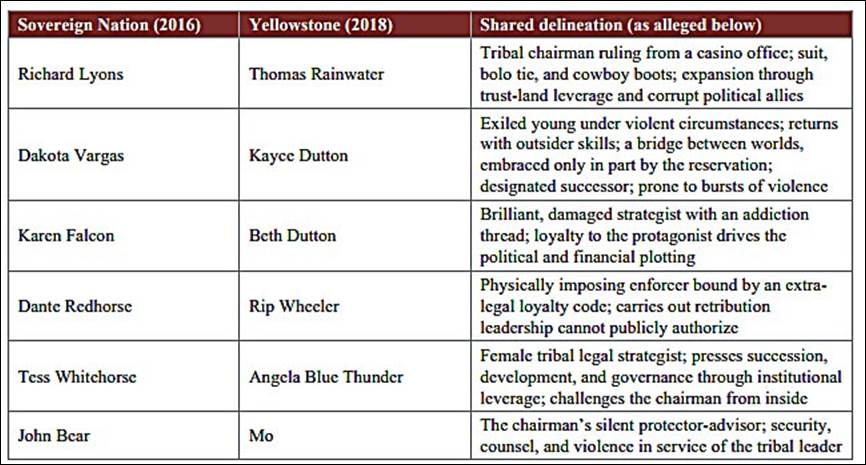
Salkin’s deck suggested that the role of the tribal chairman, Richard Lyons, go to actor Gil Birmingham, the pleading says, noting that in “Yellowstone,” the role of the tribal chairman, Thomas Rainwater, went to Birmingham. It also points out that Salkin proposed casting Danny Huston as a corrupt politician “who supplies the permits, zoning access, and political pathways,” while Huston was cast in “Yellowstone” as a corrupt land developer.
“These casting decisions constitute powerful circumstantial evidence of copying,” the complaint declares.
It maintains:
“When the concrete elements of each work are objectively compared, the similarities run across plot, themes, dialogue, mood, setting, pace, characters, and sequence of events. They are not confined to abstract concepts or genre conventions; they extend to the specific, protectable details of Salkin’s expression….”
Exploitation Alleged
The complaint says:
“Defendants have exploited that expression on an extraordinary commercial scale. Since its 2018 premiere, Yellowstone became a top-rated television series and expanded into a franchise—1883, 1923, Marshals, and Button Ranch—generating billions of dollars across broadcast, streaming on Paramount+ and Peacock, syndication, international distribution, advertising, and merchandising. To the extent the spinoff series incorporate the same protectable expression alleged in this Complaint, they too are infringing exploitations of Salkin’s work.”
It adds:
“Salkin created this world, registered it with the Copyright Office, and delivered it to Sheridan’s own representatives—who acknowledged receipt, forwarded it, and turned her away. The Yellowstone franchise has generated billions of dollars. Salkin has received nothing. She brings this action for a judgment of infringement, for the damages and profits the Copyright Act provides, and for an end to Defendants’ continuing unauthorized exploitation of her work.”
Defendants, in addition to Sheridan, include Paramount Global and NBCUniversal Media, LLC. The complaint seeks declaratory and injunctive relief, actual and statutory damages, and attorney fees.
Fickle did not respond to a request for comment on why there was an eight-year delay between the premier of “Yellowstone” and the bringing of Salkin’s lawsuit and the potential effect of the delay on the viability of the causes of action.
Copyright 2026, Metropolitan News Company