Friday, December 5, 2025
Page 3
Ninth Circuit:
OpenAI Properly Temporarily Barred From Using ‘IO’ Brand
Opinion Says No Error in Court’s Finding That There Was Likelihood of Confusion With ‘IYO’ Mark Where Names Are Homophones, Both Companies Are Marketing Devices Designed to Replace Traditional Computers
By Kimber Cooley, associate editor
|
|
|
Above are screenshots from the plaintiff’s complaint depicting the company’s IYO One device, which it describes as a revolutionary screenless audio computer. The Ninth U.S. Circuit Court of Appeals has affirmed an order temporarily blocking OpenAI Inc. and related companies from using the mark “IO” to brand similar, yet-to-be-released products. |
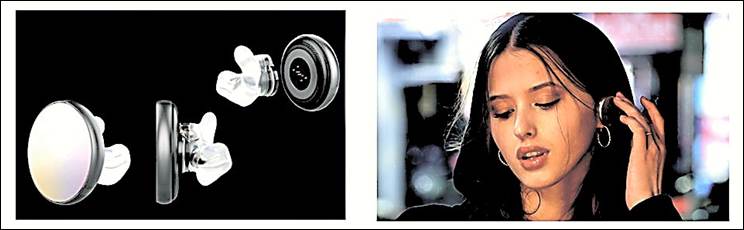
The Ninth U.S. Circuit Court of Appeals has affirmed an order temporarily blocking San Francisco-based technology giant OpenAI Inc. and related entities from using the name “IO” to market not-yet-released purportedly screenless, pocket-sized, computer-like products in a trademark infringement lawsuit brought by the Silicon Valley wearables device company IYO Inc.
According to the plaintiff, “IYO” and “IO” are homophones—each pronounced “EYE-OH”—and OpenAI was aware of the development of the IYO One device, which the company describes as “a revolutionary new kind of wearable, screenless, ‘audio computer’ that “can run apps just like a smartphone, with the user simply speaking to [earphones]” and waiting for the “apps [to] talk back,” when it announced its own IO product line.
Wednesday’s decision, by way of a memorandum opinion signed by Circuit Judges Daniel Aaron Bress, Salvador Mendoza Jr., and Senior Circuit Judge Sidney Thomas, declares that District Court Judge Trina L. Thompson of the Northern District of California did not err in finding a likelihood of consumer confusion or in ruling that the case was ripe for relief despite OpenAI not yet having any products on the market using the allegedly infringing mark.
On June 9, IYO Inc. filed a complaint against IO Products Inc., one of its founders, Jonathan “Jony” Ivie, as well as OpenAI and its chief executive officer, Sam Altman, asserting claims arising out of the Lanham Act, codified at 15 U.S.C. §1051 and California’s Unfair Competition Law, Business & Professions Code §17200 et seq., among other causes of action. That same day, the plaintiff also filed a motion for a temporary restraining order.
Allegations in Complaint
In the complaint, the plaintiff alleged that the company is “currently manufacturing…20,000 units of its IYO One” and engaging in fundraising efforts to continue to raise capital. IYO, which was founded in 2021 and has purportedly used the IYO mark continuously in commerce since 2024 in connection with other advanced audio devices, claimed:
“Defendants have known about the existence of IYO, the IYO Marks, and the nature of IYO’s technology since at least 2022. Indeed, the parties had a series of meetings with representatives of OpenAI’s principal, Sam Altman, and designers from…a…studio founded by Jony Ive (who were working with OpenAI), about the prospect of IYO and OpenAI working together.”
The plaintiff continued:
“[D]espite IYO’s rights in the IYO Mark, and despite the widespread media attention the IYO ONE has received, IYO’s momentum was stopped dead by a May 21, 2025, announcement by Defendant OpenAI that it had acquired a new company—called ‘IO’—formed with famed designer Jony Ive, for $6.5 billion. The purpose of IO? To develop hardware (and related software) which allows users to interact with their smartphones, computers, AI, and the internet without the use of screens, keyboards, mice, or other similar physical interfaces.”
In their opposition to the plaintiff’s request for a temporary restraining order, defendants asserted, among other other defenses, that the case was not yet ripe as they have yet to launch any product bearing the IO mark. Thompson rejected the assertion in the June 20 order granting the preliminary relief, saying:
“Defendants have working prototype,…the product will compete with Plaintiff’s product,…the product will be called by the disputed mark,…and the product will be released in at least a year….The Court finds these allegations are sufficient to establish an imminent injury for the purposes of ripeness.”
Thompson’s order “temporarily restrain[s]” the defendants from “using the IYO mark, and any mark confusingly similar thereto, including the IO mark in connection with the marketing or sale of related products” until “an order on a [request] for a preliminary injunction” is issued. She set the hearing for such a motion for October.
The defendants appealed the order six days later.
Appealability of Order
Bress, Mendoza, and Thomas acknowledged that TROs are not generally subject to appellate review but noted that decrees that possess the qualities of a preliminary injunction are appealable regardless of how they are described. They opined:
“Here, the order on review satisfies the two criteria that distinguish ‘between a…TRO and an appealable preliminary injunction.’…A contested process, including an adversarial hearing, was held before the district court….And the order extends well past the 14 days specified by Rule 65(b) for TROs….We therefore have appellate jurisdiction under 28 U.S.C. § 1292(a)(1).”
As to the likelihood of consumer confusion based on the purported infringing use of the IO mark, the panel explained that the court is “guided by the eight factors considered” in the 1979 Ninth Circuit case of AMF Inc. v. Sleekcraft Boats, including the similarity between the marks, the types of goods being marketed, the defendant’s intent, as well as the proximity and relatedness of the products. Applying the standard, the judges remarked:
“[T]he two factors that are ‘always’ important—similarity of the marks, and relatedness of the goods—both favor IYO….The marks ‘IO’ and ‘IYO’ only differ by one letter and are pronounced identically….The companies’ goods are also related, as both companies describe their products as replacing traditional computers and providing a more natural way to interact with artificial intelligence (AI)….While IO has not announced any details about its products yet, correspondence from IO described it as ‘competitive’ with IYO.”
Saying that “[t]he other Sleekcraft factors…either favor IYO or are neutral,” they opined that “the district court did not err in finding that IYO had shown a likelihood of confusion at this stage of the proceedings.”
Not Yet Released
As to ripeness, the panel said:
“Defendants argue that this case is not ripe because IO has not yet released or advertised a product and has no plans to do so for at least a year. But trademark infringement ‘does not require any actual sale of goods and services.’…Using a confusing mark ‘in connection with…advertising…goods’ is also actionable under the Lanham Act….Here, Defendants’ May 21, 2025 video announcement was specifically designed to generate anticipation for IO’s first product. IYO therefore has a ‘colorable claim’ that the May 21 video was itself an infringing advertisement.”
They continued:
“At a minimum…the case is ripe because IO’s alleged infringement is sufficiently imminent. Although the specifics of IO’s product have not been released, IO’s product, as the district court found, (1) already has a working prototype, (2) will compete with IYO’s product, (3) will be marketed in connection with the disputed mark, and (4) will be released in at least a year. Defendants’ announcement video confirms that IO plans to release a product sometime in 2026. IYO’s suit is thus sufficiently concrete to satisfy Article III.”
The case is IYO Inc. v. IO Products Inc., 25-4028.
Copyright 2025, Metropolitan News Company