Thursday, December 18, 2025
Special Section
PERSONALITY PROFILE
ROBERT C. BONNER
|
|
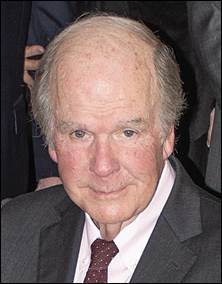
The Recipient of Presidential Appointments, He Has Led at High Levels With Skill
A judge of the U.S. District Court for the Central District of California. U.S. attorney for that district. Head of the U.S. Drug Enforcement Administration. Partner in Gibson, Dunn & Crutcher. Commissioner of the U.S. Customs Service. Head of the U.S. Customs and Border Protection. Chair of California’s Commission on Judicial Performance. Chair of the Civilian Oversight Commission for the Los Angeles County Sheriff’s Department.
That could only describe Robert C. Bonner, a man of extraordinary attainment.
Former Los Angeles County District Attorney Steve Cooley has this to say:
“In all my 50-plus years in the Los Angeles legal community, no one I know possesses the combination of professionalism and civility as does Rob Bonner. Rob’s accomplishments in important leadership positions from the local to the national level are legion and nonpareil. Gentleman, scholar, leader—-that is Rob Bonner.”
Never running for public office, high positions were conferred on him by presidents of the United States and he was wooed by a major law firm. He served the public both on statewide and local levels in various significant roles, with no financial remuneration.
Brilliant, personable, and unquestionably successful in his various endeavors, Bonner stands out as one of the most accomplished lawyers in California’s history.
Bonner acknowledges that he’s had an atypical career, alternating between senior government service and high stakes private practice.
“Being able to do this,” he says, “is one advantage of being a lawyer. But it was my parents who inculcated the notion that public service, contributing to the greater good of society, is an obligation for those in a position to do so.”
His career models, he notes, were Warren Christopher (now deceased), a Los Angeles lawyer with O’Melveny & Myers who became the secretary of state under President Jimmy Carter, and James Baker, a Texas lawyer who was secretary of state under President George H. W. Bush.
Born in Wichita, Kan. on Jan. 29, 1942, and reared in that city by a father who was a lawyer and a mother who was a school teacher, he went off to the University of Maryland, from which he received an undergraduate degree magna cum laude in 1963, then to the Georgetown University Law Center in the District of Columbia, graduating in 1966.
Moves to California
Relocating to the other side of the continent in 1966, Bonner became a law clerk in Los Angeles for U.S. District Court Judge Albert Lee Stephens Jr. of the Central District of California.
After his one-year clerkship, Bonner entered the U.S. Navy and served for three years during the Vietnam War in the Judge Advocate General Corps, including a tour as the legal officer on the aircraft carrier USS Franklin Roosevelt. He rose to the rank of lieutenant commander.
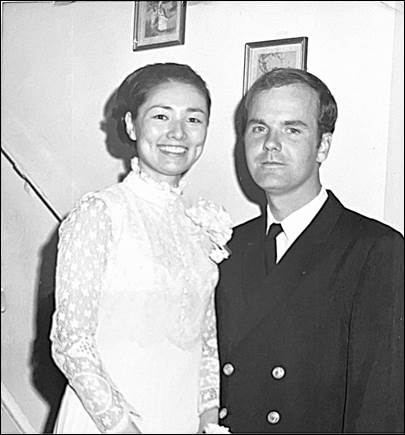
It was during this period that Bonner became a husband. Wed on Oct 11, 1969, he and Kimiko Tanaka Bonner have been married for 56 years.
|
|
|
Bonner and Kimiko Tanaka on their wedding day, Oct. 11, 1969. |
Coming out of the Navy in late 1970, Bonner set his sights on becoming a federal prosecutor in the Central District of California. His interest in the post was piqued when he was a law clerk, seeing that there were assistant U.S. attorneys (“AUSAs”), not much older than he, who were trying cases in the majestic courtrooms at 312 North Spring Street (now a Los Angeles Superior Court facility).
He served as an AUSA there for 4½ years, trying approximately 45 cases to verdict or judgment. Some of his notable trials included the kidnapping of Larry Adel, 15, of Palm Springs, and the Laguna Niguel bank burglary, where a Mafia-affiliated gang, in Mission Impossible-style, dynamited the vault of a United California Bank in Orange County and made off with millions of dollars worth of cash and valuables from safe deposit boxes. He also prosecuted the largest public corruption case in the nation at the time, some 70 defendants working in Los Angeles’s meat packing industry, all of whom were convicted, including every U.S. Department of Agriculture meat grader in the area.
Fellow Prosecutor Comments
Recalling Bonner’s service as an AUSA, a fellow federal prosecutor from that era, Vincent J. Marella—who went on to become a founding partner of a major law firm, Bird, Marella, Rhow, Lincenberg, Drooks, & Nessim, LLP—says:
“Rob personified the ideal assistant U.S. attorney. During his tenure, he brought his enormous natural talent as a lawyer to the task of prosecuting some of the most significant and sensitive cases brought by the U.S. Attorney’s Office. He had extraordinary judgment in initiating prosecutions coupled with a work ethic and a rare talent for successfully bringing cases to a successful conclusion. All of this, plus an unwavering code of ethics and sense of fairness, made Rob the best prosecutor the people of the Central District of California could hope for.”
Bonner left the U.S. Attorney’s Office in 1975 and became a partner in the Los Angeles firm of Kadison, Pfaelzer, Woodard, Quinn & Rossi. He built a reputation as a trial lawyer handling complex civil litigation and white-collar defense. In one prominent case, Bonner defended VSL Corporation, a subsidiary of a Swiss company, which was the subject of five separate indictments for price fixing in multiple federal districts.
Presidential Appointments
The lawyer has held five presidentially appointed-Senate confirmed positions, starting with his appointment as the United States attorney for the Central District of California by President Ronald Reagan. He credits then-U.S. Sen. Pete Wilson with putting his name forward to the White House.
As U.S. attorney, Bonner led the prosecutions of a dozen defendants charged with kidnapping and murdering DEA Agent Kiki Camarena in Mexico. Though few U.S. attorneys enter courtrooms, he personally prosecuted the first FBI agent ever indicted for espionage. He reorganized the U.S. Attorney’s Office to focus on government and securities fraud and public corruption. And his office prosecuted two of the largest money laundering cases in the history of the U.S. Justice Department, “Operations Pisces” and “Polar Cap.”
Richard Drooyan, who was chief assistant U.S. attorney under Bonner—now a partner in the Los Angeles firm of Munger, Tolles & Olson LLP—remarks:
“Rob Bonner had exceptional leadership skills and never shied away from making the toughest investigative and prosecutive decisions on the most complex and difficult cases handled by the U.S. Attorney’s Office. During his tenure as the United States attorney, he was responsible for elevating the profile and reputation of the U.S. Attorney’s Office for the Central District of California as one of the pre-eminent prosecution offices in the country.”
Nominated as Judge
After more than five years as a U.S. attorney, Bonner became the first of President George H.W. Bush’s nominees to a District Court post. He was confirmed by the Senate on May 18, 1989.
A colleague on the court was Dickran Tevrizian, now an arbitrator/mediator. He says:
“Rob and I have been friends for over 50 years when we first met when our daughters attended Mayfield Junior School in Pasadena. I have always respected Rob as a person and as a public servant. He has distinguished himself as an extremely competent individual with the highest integrity. Rob is the ‘gold standard’ in the legal profession for excellence.”
Bonner’s tenure on the court lasted less than two years, as Bush asked him to lead the Drug Enforcement Administration (“DEA”). Bonner says he faced “one of the most difficult decisions” in his career. His goal had been to become a judge of the District Court—a job he was enjoying. But, he remarks, “when the president asks you to do something for the country, who am I to say no?”
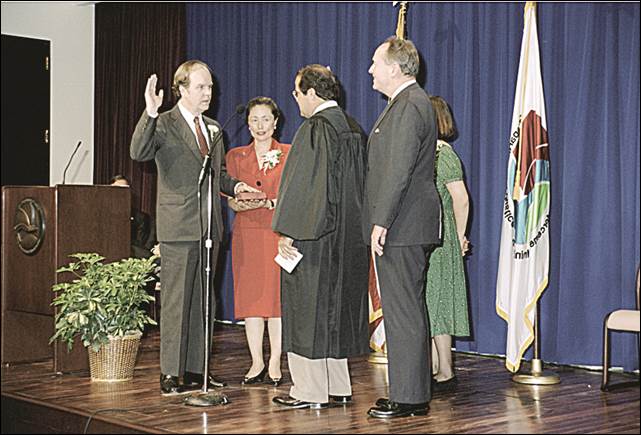
Bonner was sworn in by U.S. Supreme Court Justice Antonin Scalia, since deceased, as the DEA administrator in August 1990.
|
|
|
Bonner being sworn in by U.S. Supreme Court Justice Antonin Scalia, since deceased, as the DEA administrator in August 1990. |
Doug Wankel, the former head of DEA Operations, says of Bonner:
“Due to his many contributions to DEA during his tenure as administrator, including the creation and successful implementation of the Kingpin Strategy, his establishment of the DEA Intelligence Division, his fostering of unprecedented cooperation and collaboration among U.S. government entities including the Department of Justice, Department of State, the Department of Defense and the Intelligence Community, Robert Bonner is widely considered the most consequential and respected administrator in the more than 50 years history of the Drug Enforcement Administration.”
Most presidential appointees have their resignations accepted when the party occupying the White House changes. However, at the request of Warren Christopher, head of President Bill Clinton’s transition team, Bonner agreed to stay into the first year of the Clinton Administration.
In late 1993, Bonner returned to Los Angeles and became a partner at Gibson, Dunn & Crutcher where he specialized in white collar defense and commercial litigation. His clients included Ray Irani, CEO of Occidental Petroleum, Milan Panic, CEO of ICN Pharmaceutical, and Jerry Lewis, longtime congressman and chair of the powerful House Appropriations Committee. In a highly publicized trial, he and his law partner Thomas E. Holliday, now deceased, defended Hollywood Madam Heidi Fleiss on her federal tax evasion charges.
Heads Customs Service
In April 2001, President George W. Bush nominated Bonner to be commissioner of the U.S. Customs Service. Bonner moved to the District of Columbia and began running U.S. Customs in earnest on the morning of the 9/11 terrorist attacks. At 9:55 a.m. he ordered U.S. Customs to go to highest level security alert at all of the nation’s 328 ports of entry. Bonner says that he immediately realized that the priority mission of the department was no longer interdicting drugs and collecting duties; it was keeping terrorists and terrorist weapons from getting into the country.
To secure the borders against international terrorism without shutting down legitimate trade and travel, Bonner implemented many of the most revolutionary initiatives of any agency of the federal government in the post-9/11 era, including the Container Security Initiative, the Customs-Trade Partnership Against Terrorism, the 24-Hour Rule, the National Targeting Center, and Global Entry. All these initiatives involved mandating advance information about cargo and passengers before they arrived and using intelligence-driven risk targeting to identify those few that posed a risk.
Attorney Brian Goebel, who served as counselor and senior policy advisor to Bonner from 2001-04, remarks:
“At a time when political appointees were working frantically to safeguard the country, no one, and I mean no one, worked harder or smarter than Rob Bonner. In his first 18 months on the job, Rob literally revolutionized international travel and trade, achieving previously unthinkable gains in security and efficiency.”
Leads Unified Agency
After the homeland security reorganization of late 2002, President George W. Bush appointed Bonner to be the first head of U.S. Customs and Border Protection (“CBP”), a merger of frontline immigration, agriculture inspectors, and the Border Patrol with U.S. Customs, to create one, unified border agency for our country. With more than 50,000 employees, CBP was the largest actual merger of people and functions within the then new Department of Homeland Security.
|
|
|
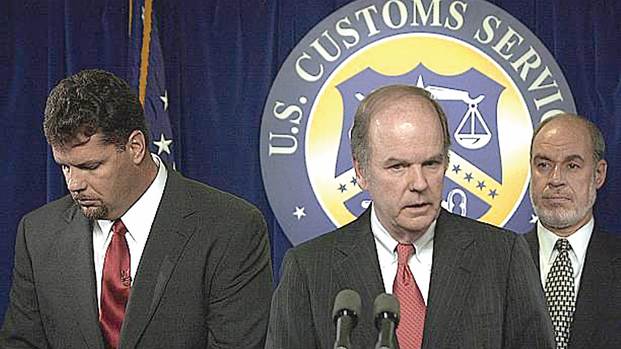
Bonner speaks at a press conference in 2002 in Washington, D.C. At left is Special Agent Mike Netherland, assistant director for the US Customs CyberSmuggling Center; at right is John Rabun, Jr, vice president of the National Center for Missing and Exploited Children. |
Thomas J. Ridge, the first secretary and director of the Office of the Department of Homeland Security, serving from 2001-03, relates:
“Immediately upon my arrival at the White House, just weeks after the 9/11 attacks, Rob impressed me as someone who was getting things done at U.S. Customs. I had no hesitancy in recommending to President Bush that Rob be named the first commissioner for the newly created border agency for our country, U.S. Customs and Border Protection (CBP), one of the key components of the Department of Homeland Security. CBP was the largest merger of people and functions within DHS and I trusted Rob to make that merger work. He did so with great professionalism and distinction and our nation is safer to this day as a result.”
In late 2005, Bonner resigned as CBP commissioner and returned to Gibson Dunn. In 2008, he retired as a partner of the firm but stayed on in an of counsel role until 2012.
For much of the 2010s, Bonner was a part owner and the senior principal in the Sentinel Group, a Washington, D.C.-based homeland security consulting firm. In 2018, he sold his interest in Sentinel and since then has devoted the majority of his efforts to being an alternative dispute resolution neutral. He continues to serve as an arbitrator, including often chairing arbitrator panels. He mediates commercial disputes as part of Phillips ADR Enterprises, a mediation firm founded by former U.S. District Court Judge Layn Phillips of the Western District of Oklahoma.
Chairs CJP
Appointed by then-Gov. Pete Wilson, Bonner served as the first non-judge chair of the Commission on Judicial Performance.
Reflecting on Bonner’s long career, Wilson points to the U.S. Supreme Court 1935 opinion in Berger v. United States where, the former governor recites, “it was stated that a federal prosecutor represents a sovereignty with an obligation to govern impartially, and their interest in a criminal prosecution is not to win, but to ensure that justice shall be done.”
He continues:
“The prosecutor is a servant of the law, aiming to prevent the guilty from escaping and the innocent from suffering. While they should prosecute with vigor, they must not strike unfairly. This is the gold standard that Rob has practiced throughout his entire professional career, as a judge, a government lawyer, and in private practice. This is why I have been such an enthusiastic supporter of Rob’s for over half a century. His contributions to ensure justice and decency have been served are most admirable and more numerous than I can count.”
County Commission
More recently, he served as chair of the Civilian Oversight Commission for the Los Angeles County Sheriff’s Department, assuming the post in 2017 when the agency was founded. For reasons that are still not clear, Supervisor Kathryn Barger on May 13 advised Bonner that his appointment to the unpaid position would not be renewed and then refused to meet with him to discuss his wish to remain until the end of the year to finish up work.
The commission said in a July 22 press release:
“Under Bonner’s leadership in FY 2024-2025, the Commission pursued revisions to its governing ordinance to ensure effective oversight. It issued subpoenas for confidential documents about deputies’ use of force, which the Los Angeles County Sheriff’s Department has challenged in court, and it also filed a resolution in support of Assembly Bill 847, which seeks to enable civilian oversight commissions to access confidential personnel information needed to perform their functions and to go into closed session to review this information.”
For the last decade, he has been a trustee of the California Institute of Technology, chairing its Audit & Compliance Committee. At age 70, Bonner took up the guitar and plays rhythm guitar and sings 60s Rock songs in the Bonner Boys Blue Band.
Summing up his career, Bonner says:
“I have been very fortunate to have a fascinating career involving both public service and private practice, and, I should add, to have an exceptionally supportive spouse who went along with it all.”
Bonner and his wife Kimi reside in Pasadena. They have one child: daughter Justine Mitsuko Bonner, an assistant federal public defender for the District of Oregon.
Principal contributor to this profile was Connie Dawson.
Copyright 2025, Metropolitan News Company