Thursday, December 18, 2025
Special Section
PERSONALITY PROFILE
LINDA LIU SUN
|
|
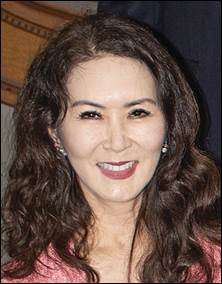
She Is a Stellar Judge Marked by Competency, Compassion, Commitment
The Sun is a star. And Judge Linda Liu Sun is a rising star on the Los Angeles Superior Court.
Here’s what her colleagues say about her:
• “Presiding over dependency matters at the Edmund D. Edelman Children’s Courthouse, Judge Linda Sun is widely admired for her careful, thoughtful demeanor and steady leadership. This richly deserved recognition celebrates her meaningful contributions and her unwavering commitment to ensuring equal access to justice for every family she serves.”
RICARDO R. OCAMPO
assistant presiding judge
• “Judge Linda Sun is an exceptional bench officer.
“She is not only generous, but she is kind, patient and gracious.
“She has a courtroom that is welcoming and collaborative.
“Attorneys, staff, the bench, and the communities we serve, are all the beneficiaries of her hard work, dedication and care.”
AKEMI ARAKAKI
presiding judge, Juvenile Court
• “Judge Sun is a pleasure to work with and an asset to the bench. The attorneys and staff appreciate the courtroom culture that she has fostered, and everyone enjoys the celebratory atmosphere she creates to honor the accomplishments of children and families.
“Her professionalism, work ethic, and dedication to serving system-involved families is exemplary. She should be very proud of this much-deserved recognition.”
D. BRETT BIANCO
supervising judge, Juvenile Division
• “Although I have not had the pleasure of working with Judge Sun, I have had the pleasure of getting to know her through various colleagues. She is truly the real deal. She’s authentic in every way. She has both intelligence and kindness in abundance.”
YVETTE VERASTEGUI
supervising judge, Criminal Courts
• “Judge Linda Sun’s dedication, compassion, and service in the Dependency Court have made a profound impact on the lives of numerous children and families. Judge Sun has consistently demonstrated an unwavering commitment to protecting the rights and well-being of children while supporting families through some of their most challenging times. She has ensured that every child’s voice is heard and that every family’s circumstances are considered with empathy and fairness.
“What sets Judge Sun apart is her deep personal commitment to supporting and uplifting the children and families who appear before her. She often purchases books, toys, school supplies, and other gifts to give to each child at every court appearance. Her generosity, kindness, and dedication to helping others extend beyond the courtroom.
“She has mentored and inspired countless students and attorneys. She served as the chair of the Los Angeles Chapter of the International Youth Leadership Foundation, where she founded the Youth Leadership Workshop and Scholarship. Her work on and off the bench has touched the lives of many and has inspired us all.”
JANA M. SENG
assistant supervising judge, Criminal Courts
• “At the Edelman Children’s Court, we all admire Judge Sun’s tremendous work ethic: she is the first one in and the last one out of the courthouse every day. But more importantly, in my view, she exhibits a unique commitment to service and deep care for others.
“As a relative newcomer, I have benefited from her inclusivity, generosity, and partnership. She has quickly become a treasured friend, and I am proud to serve with her.”
SALLY ESPINOZA
judge
• “Judge Sun is one of those rare friends and colleague that you wish for. She makes everyone feel welcome and supported both inside and outside the courtroom. She leads by example and is often the first person to arrive at work and the last one to leave. She has also found ways to lift the morale of her colleagues with her infectious laugh and by organizing monthly mingles and after hour gatherings.
“Judge Sun has shined in this Dependency assignment and says ‘it is her calling.’ It is my privilege to celebrate Judge Sun, a dedicated public servant, devoted wife and mother and fearless world traveler.”
LISA A. BRACKELMANNS
commissioner
Deputy County Counsel Jackee Montano, who is assigned to the Dependency Court, has this to say:
“I worked with Judge Sun in the courtroom for about two years. She is exactly the kind of judge L.A. County families need on the bench! Thoughtful, thorough, and exemplary at catching details that really matter in a case.”
That she is a success as a judge is without question. Beyond that, her life constitutes a “success story.”
She was born in Hong Kong and brought up in Taiwan. Fluent in Mandarin and Cantonese, she also studied French in high school. Sun attended Maryknoll Convent School, an all-girls Catholic school.
|
|
|
|
Linda Liu Sun is seen is the arms of her mother, Yamei Liu, in this photograph. Holding her older brother, Mark Liu, is her father, Ming Liu, now deceased. |
|
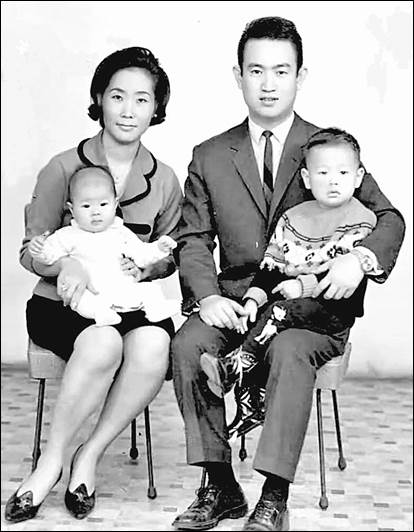
Her parents, both instructors of Mandarin as a second language, were of modest means. Sun recounts:
“Becoming a judge was not something I ever envisioned while growing up or even early in my legal career. As a teenager, my parents spent their entire life savings to send my brother and me to the United States for a college education while they remained in Hong Kong to work. Their goal was simple: that we would graduate, find work immediately, and later join them when their immigration was approved.”
Sun came to the United States, alone, at the age of 18. She began her college studies at Notre Dame de Namur University (formerly the College of Notre Dame) and transferred to UCLA in her junior year, earning a bachelor’s degree in economics in 1988.
Joins Eu’s Office
After working several jobs, she joined the office of California Secretary of State March Fong Eu, now deceased, as a special assistant in 1992. When Eu was appointed U.S. ambassador to the Federated States of Micronesia in 1994, their close bond deepened; Eu became Sun’s godmother and encouraged her to pursue law school.
That same year, she and Albert Sun were wed. He is the executive vice president at Manhattan Beach Studios.
|
|
|
Above is a photograph taken at the 2004 wedding of Albert Sun and the then-Linda Liu. |

Under the mentorship of U.S. District Judge Ronald S.W. Lew of the Central District of California, now deceased, she enrolled in the night program at Southwestern University School of Law while working full-time. She earned her J.D. in December 1999 and passed the February 2000 State Bar exam, the same year her daughter Seraphine was born.
Sun became a U.S. citizen in 1998. Her legal career, shaped profoundly by Eu and Lew, reflected a strong commitment to public service and a desire to serve as a role model within her community.
Her father, Ming Liu, died in 2004, the year her son Skylor was born.
|
|
|
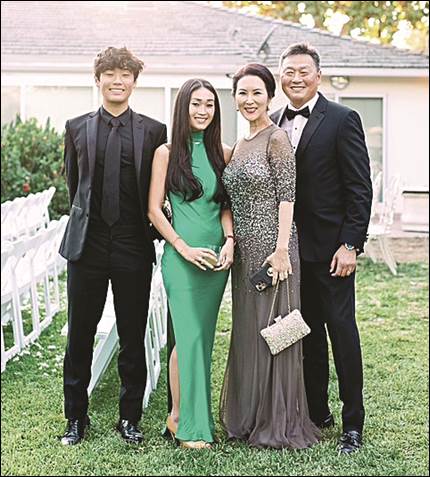
Pictured are the Suns: Skylor, a junior at Cornell University; Seraphine, who graduated from USC with a degree in international relations and this year obtained a paralegal certificate from UCLA; and parents Linda and Albert Sun. |
Before ascending to the bench, Sun built a career in public service. From 2001-20, she served at the California Department of Justice, first as a deputy attorney general and later as a supervising deputy attorney general. Her work involved complex consumer protection litigation and representation of more than 40 state agencies in actions involving professional licensees.
“After nearly two decades at the Attorney General’s Office, I sensed it was time for a new challenge,” Sun says. “That desire for growth ultimately led me to run for judicial office.”
Sun was elected to the Los Angeles Superior Court in the March 3, 2020 primary, in a bout with Deputy District Attorney Robert “Bob” Villa, garnering 57.34% of the vote. She became the first Chinese American elected to that court. She was officially enrobed on Jan. 4, 2021, and her current term extends through January 2027.
Dependency Court
She presides over dependency cases in the Edmund D. Edelman Children’s Courthouse in Monterey Park. The judge remarks:
“I feel extraordinarily fortunate that dependency became my first judicial assignment. Dependency Court is where the justice system confronts its most solemn responsibility: protecting children while striving, whenever possible, to preserve and heal families. Each case presents a delicate balance between urgency and hope—urgency to prevent harm and hope that families can safely reunify through treatment, support, and meaningful change.
“Dependency work is profoundly collaborative. Judges, attorneys for the Department of Children and Family Services, parents, and children work together to determine how best to support families and mitigate trauma. The role is part social work, part therapy, and part judging. I share the joy when families reunify, and I feel the heartbreak when reunification cannot be achieved. Success depends on coordinated efforts across agencies to connect families with the resources they need, and their willingness to engage.”
Nature of Judges
Sun reflects:
“One of the most persistent misconceptions about judges is that we are omnipotent. In truth, we are public servants entrusted with upholding the Constitution and applying the law impartially. This responsibility requires neutrality, courtesy, and continuous self-examination. We must remove bias from our thinking, see each stage of each case with fresh eyes, prepare diligently, manage our calendars efficiently, and practice active listening.
|
|
|
Ziplining in 2018, Sun is seen gliding over trees on a cable. |

“Serving on the bench has transformed my understanding of justice. It is not simply the application of rules; it is the careful balancing of principles and compassion, especially when resources are limited. It requires constant reflection, humility, and a willingness to improve.
“I am acutely aware that my decisions affect people’s lives in real time—sometimes profoundly. I strive to give all parties a genuine opportunity to be heard. I encourage litigants to speak directly to me, on or off the record, and I make it a point to engage with children, offering comfort and encouragement. I applaud parents who make progress, treat each hearing as a fresh start, and ensure transparency in my expectations. Above all, I make certain that every person who enters my courtroom feels respected and understood.”
Beyond her judicial duties, Sun has undertaken mentorship and community involvement. She participates in outreach programs designed to encourage young people, particularly those from underrepresented backgrounds, to explore careers in law and public service.
★★★★
Sun Had a Mentor and Friend: Judge Ronald S.W. Lew
Not many U.S. District Court judges are beloved figures within the legal community. Ronald S.W. Lew decidedly was.
Lew, who died May 19, 2023, was a mentor to 2025 “Person of the Year” honoree Linda Liu Sun. He had himself been so designated in 1998, drawing an attendance at a 1989 dinner solely in his honor of 309 persons.
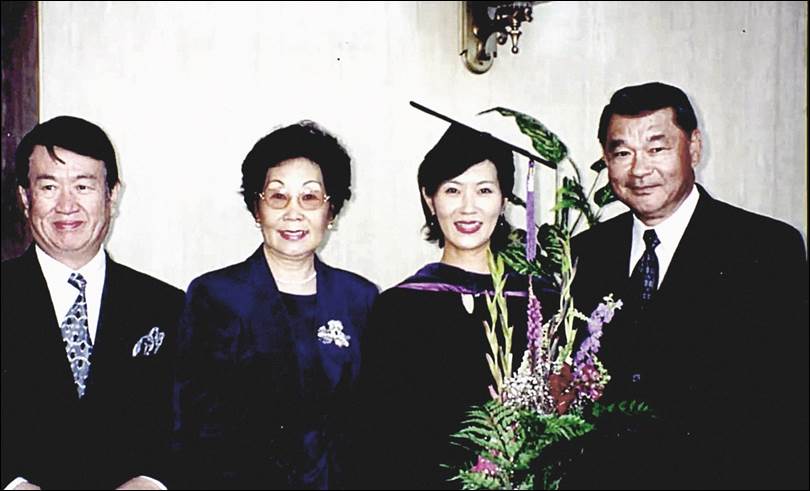
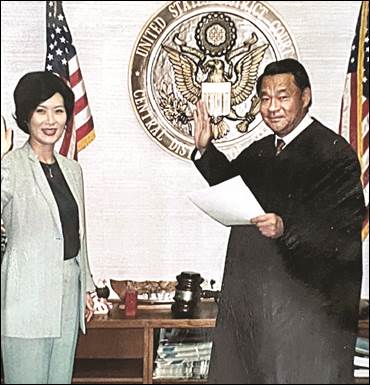
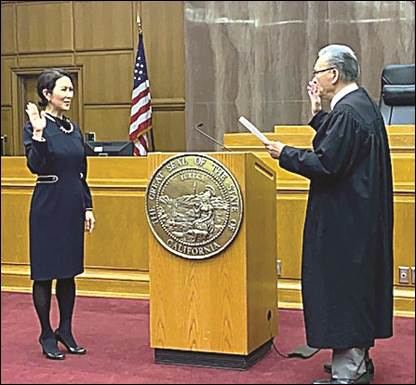
Below are photographs of Lew with Sun: the top one showing him, at right, in attendance at her law school graduation (with parents Ming and Yamei Liu at left); the bottom left shot depicting Lew swearing in Sun as a member of the State Bar; and at bottom right he is seen administering the oath of office as a Los Angeles Superior Court judge.
|
|
|
|
|
|
By Linda Liu Sun
I was introduced to Judge Lew while I was working for March Fong Eu in 1992. I’m not sure how it happened—Judge Lew could have made a comment about March’s newly acquired Mandarin skills (taught by my mother) at that time. So I asked my mother if she would be willing to teach Judge Lew as well, and she gladly accepted. My mother then became March and Judge Lew’s Mandarin teacher.
In 1994, when March was appointed to serve as the U.S. ambassador to the Federated States of Micronesia, she became my godmother and urged me to attend law school—advice that changed the course of my life. She mentioned that her son, former state Treasurer Matt Fong, was guided by Judge Lew to pursue a law degree from Southwestern.
Immediately, I reached out to Judge Lew. More than a jurist of great integrity, he was a generous mentor who saw potential in me long before I saw it in myself. He taught me that the law is the backbone of our country—the foundation upon which all other professions stand—and that with this privilege comes a profound duty to serve with fairness, humility, and compassion. Proud of his heritage, he strove to be a role model not through his words, but through his example.
Everyone who knew him would remember that it would not be possible to not have lunch with him at a dim sum restaurant in Chinatown. He would address the servers by their names and joke with everyone. He was the proud co-founder of the Chinese American Museum, a project that was dear to his heart. He later nominated me to serve on that board. I carry his lessons with me every day, and his legacy lives on in all those he mentored and inspired.
After my wedding in 1994, I applied to Southwestern, Judge Lew’s alma mater.
In 1998, while in law school, I received my citizenship. Unbeknownst to me, it was especially meaningful that the 5,000-new citizens’ naturalization ceremony was performed by none other than Judge Lew.
That moment forever intertwined his legacy with my American journey. Years later, he performed a private naturalization ceremony for my parents because my father was gravely ill at the time. During the last semester of law school, I externed for Judge Lew and sat for the February 1999 bar exam. When the results were released, he was initially worried that he could not find my name in the newspapers. He was relieved when he discovered my name on a separate list published the following day.
Needless to say, Judge Lew became an integral part of my career. He attended my law school graduation ceremony, administered my attorney’s oath and included me in his annual “Lewnar” New Year luncheon.
After having spent almost two decades at the Attorney General’s Office and sent my first child Seraphine to college, I decided to run for a judgeship. The first person I consulted with was Judge Lew. Over lunch at his favorite dim sum restaurant, the first question he asked me was, “Why did it take you so long?”
Copyright 2025, Metropolitan News Company