Thursday, December 11, 2025
Page 1
Ninth Circuit:
Putative Class Action Over ‘Air Fried’ Label Was Rightly Axed
Majority Says District Court Judge Properly Applied California Law in Dismissing Complaint Asserting That Potato Chips Are Deceptively Labeled by Campbell Soup Co. as ‘Air Fried,’ Noting Bags Also Indicate That Product Is ‘Kettle Cooked’
By Kimber Cooley, associate editor
|
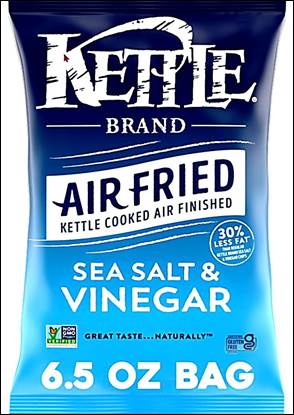
A divided panel of the Ninth U.S. Circuit Court of Appeals held yesterday that a District Court judge properly dismissed a putative class action alleging that Campbell Soup Company deceptively labels chips as “Air Fried” when the preparation purportedly involves dipping the snacks in a “vat of oil,” finding that other descriptions on the packaging indicating that the items are “Kettle Cooked” cure any reasonable confusion.
Syed Husain, a resident of San Mateo County, filed his putative class action complaint against the New Jersey-based company on March 22 of last year, asserting unfair competition and false advertising claims under California’s Business and Professions Code §17200 et. seq., the Unfair Competition Law, and §17500 et seq., the False Advertising Law. In the operative pleading, Husain alleged:
“The phrase on the front…and…back label, ‘Kettle Cooked Air Finished’ does not remedy the deceptive nature of the ‘Air Fried’ representation. First, the phrase ‘Kettle Cooked’ is false. The Product is not cooked in ‘kettles,’ as admitted by at least one representative of Defendant. Second, the phrase ‘Kettle Cooked’—even if it had been true—implies the use of steam, rather than oil, since kettles are commonly associated with boiling water….Third, the phrase is in orders of magnitude smaller than the ‘Air Fried’ representation. Finally, the phrase is, at best, ambiguous since ‘Kettle’ is the brand name, leaving reasonable consumers to interpret the phrase…as a marketing jingle.”
Plaintiff’s Intent
He sought to represent “[a]ll persons who purchased any of [the purportedly deceptively-labeled products]…from on or about February 15, 2023, to the date of class certification.”
Last September, Senior District Court Judge Charles Breyer of the Northern District of California granted the defendant’s request to dismiss the operative complaint, saying: “Because the front label discloses that the Product is kettle cooked, Plaintiff’s case, too, is fried. The Court GRANTS the motion to dismiss.”
Majority Opinion
Yesterday’s memorandum decision, signed by Senior Circuit Judge Sidney R. Thomas and Circuit Judge Daniel Aaron Bress, affirms the dismissal of the case under Federal Rule of Civil Procedure 12(b)(6) for failure to state a claim, declaring:
“Under California law, deceptive advertising claims are governed by the ‘reasonable consumer’ test, which ‘requires a probability that a significant portion of the general consuming public or of targeted consumers, acting reasonably in the circumstances, could be misled.’…To determine whether a product label plausibly deceives, we first look at the challenged product’s front label….
“Here, Husain fails to plausibly allege that a reasonable consumer would be deceived into believing that the chips are not deep fried in oil. The front of the packaging prominently states that the chips are not just ‘Air Fried,’ but also ‘Kettle Cooked Air Finished.’ The front label therefore expressly describes a two-step process that involves both kettle cooking and air frying. The suggestion that the chips are exclusively air fried is belied by the plain language of the front of the packaging. And we agree with the district court that reasonable consumers would understand ‘kettle cooked’ to refer to the commonly understood method of deep frying potato chips in oil. Husain’s contention that “kettle cooked” could refer to potato chips being cooked in water or steam is not plausible.”
Adding that “even if the front label is ambiguous, the rest of the packaging cures any ambiguity,” they pointed out that the ingredients list includes “vegetable oil” and remarked:
“There is also a pictorial depiction of potato slices being dropped into a vat of boiling liquid that a reasonable consumer would understand to be oil, especially given the visible droplets bubbling out of the pot. Given this context, no reasonable consumer unsure of the meaning of the front label would be deceived into thinking that the chips are not deep fried in oil.”
Disagreeing with that analysis, Circuit Judge Salvador Mendoza Jr. penned a dissent, saying:
“The majority’s conclusion that no reasonable consumer could be misled by the Campbell Soup Company’s ‘Air Fried’ chip packaging departs from the plausibility standard that governs at the motion-to-dismiss stage and misconstrues how reasonable consumers (rather than judges parsing labels with technical precision) interact with food claims in a typical marketplace.”
Mendoza wrote:
“At the Rule 12(b)(6) stage, our task is only to determine whether a ‘reasonable consumer’ could at least plausibly conclude what the front of this packaging obviously intends to communicate: that the chips are exclusively ‘Air Fried.’ The complaint alleges exactly that, and the labeling readily supports it..”
Noting that the defendant admitted at oral argument that “kettle cooked” is an “industry” term, he continued:
“Consumers purchasing bags of chips at a store are not required to understand formalized industry jargon or technical food-processing methods. The suggestion that a reasonable consumer would read ‘kettle cooked’ as ambiguously qualifying the clearly-implied sole method of frying, rather than plausibly indicating parboiling, steaming, or other alternative chip-cooking methods, is inconsistent with the way we evaluate labels at the motion-to-dismiss stage and contrary to how the everyday grocery store shopper views packaging.”
As to the majority’s reliance on the advertised fat content, he opined:
“The majority contends that a reasonable consumer simply must know and conclude that the presence of any fat or oil necessarily means that the chips are also deep fried. But, again, the majority is simply incorrect. Air frying does not suggest the use of no oil or fat, but a lesser use of oil that is placed on the chips so that they fry via circulating hot air. By misconstruing the utility of the 30% Less Fat label in misleading a reasonable consumer, the majority also misconstrues Husain’s complaint, which focuses on whether the packaging communicates that the chips are deep fried, not whether the chips have any oil or fat.”
The case is Husain v. Campbell Soup Company, 24-6041.
Copyright 2025, Metropolitan News Company