Tuesday, October 25, 2011
Page 7
PERSPECTIVES (Column)
Granger Conducts Defense in Criminal Case While Serving as District Attorney
By ROGER M. GRACE
149th in a Series
LEWIS GRANGER, though overlooked by historians as the second district attorney of Los Angeles County, did serve in that role from 1851-52, an appointee of the Court of Sessions to fill a vacancy. However, only specks of information as to his activities in office are to be found.
The Nov. 26, 1851 issue of the Alta California picks this up from the Nov. 8 edition of the Los Angeles Star:
“We are informed that a complaint has been lodged with the District Attorney against certain persons who have been converting to their own use timber, tiles, &c, which belong to the Mission San Gabriel. It is said that as many as four large dwelling houses have been constructed from the materials thus carried away, and that some of the Mission buildings have been unroofed by parties who have appropriated to themselves the materials. Under the supposition that the Missions are the property of the United States, many individuals are pursuing a course which in the end may remit to their disadvantage; for until the Commissioners look into the titles, there must be doubt as to what party the ownership belongs. District Attorney Lewis Granger has taken the proper steps in the premises.”
“Launcelot Granger of Newbury, Mass., and Suffield, Conn.,” by James Nathaniel Granger, published in 1893, is one of only two books of which I’m aware recognizing that Lewis Granger had served as district attorney…though both errantly recite that he was elected to the post. (The other book is “Letters of Lewis Granger,” published in 1959, reciting his service as DA in the preface.) The 1893 genealogical reference work says of Lewis Granger:
“[U]pon him fell the duties of prosecuting the criminals of that murderous section, his own position was one of more than ordinary danger. But his coolness and known courage carried him safely through the arduous duties of his office. It is estimated that there were at Los Angeles in those years, more desperadoes than at any other spot on the Pacific coast, San Francisco not excepted, and more on the coast than in any other one part of the known world.”

The March 6, 1852 issue of the Los Angeles Star lists 12 proceedings that had been heard in the District Court before Judge Oliver S. Witherby, with attorneys for each side identified. Two of the criminal cases mention “Lewis Granger, Dist. Attorney.” Granger is also listed as defending the county in two civil actions, the DA at that point performing services now undertaken by county counsel.
Surprisingly, Granger is shown as the attorney for a defendant in a criminal action, with William G. Dryden’s name appearing as “Dist. Attorney pro tem.” Professional ethics were, at that point, largely undeveloped.
(Dryden was elected as a county court judge in 1855 and served in that role until his death in 1869.)
While it does appear inordinate for a district attorney to be handling the defense of an accused criminal, the fact that Granger had private clients while DA reflected the norm, at least as to clients in civil cases. In those days, and going forward into the early 1900s, the district attorney’s job was a part-time one, just as service as city attorney for smaller cities in the County of Los Angeles is today, with the holder of the office being at liberty to maintain a private law practice.
Here from the Nov. 8, 1851 issue of the Los Angeles Star is an ad (or “legal card”) which appeared recurrently in that publication:
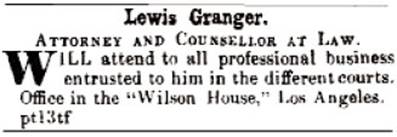
The Wilson House was on the west side of Los Angeles Street, situated in what is now Fletcher Bowron Square. “The Los Angeles Star, 1851-1864,” a 1947 book by William B. Rice, describes the structure as “a small frame house.” The Star also had its office there. “Annals of Los Angeles” by Joseph Gregg Layne, published by the California Historical Society in 1935, notes that the “little building” was “directly behind the Bella Union Hotel” on Main Street.
Later ads in the Star reflect that Granger moved to “Garfias’ Building.” I assume that refers to the adobe residence of Manuel Garfias at First and Main streets, alluded to by W.W. Robinson in his 1979 book, “Land in California.” Garfias was Los Angeles County’s first treasurer.
Granger served about nine months as DA. The July 7, 1852 issue of the Los Angeles Star reports:
“Lewis Granger, Esq., has resigned the office of District Attorney, and the Court of Sessions has appointed Kimball H. Dimmick, Esq., to fill the vacancy thus created.”
An announcement dated July 17, 1852, appearing in consecutive issues of the Star, says that attorneys Jonathan R. Scott and Lewis Granger were open for business in an office “opposite the Bella Union, Main Street.” That would have been on the west side of Main Street where the U.S. District Court Building is now.
The Bella Union, at 314 North Main Street, was the city’s first hotel. It also housed the courtroom where a shoot-out might well have occurred in the Lugo case, previously discussed here, had the cavalry not arrived.
Scott had been the first justice of the peace for the City of Los Angeles and was one of two JPs in the county who served as the initial associate judges of the Court of Sessions (which had both judicial and executive powers). He was then a member of the area’s first law partnership, practicing with Los Angeles County Attorney (later state District Court judge) Benjamin Hayes.
(Previously noted here was Hayes instituting a prosecution of the Lugo Boys in the court of Scott, his law partner.)
Upon teaming up with Granger, Scott became the partner of a former district attorney. He was also the father-in-law of a future DA, Albert B. Chapman, who studied law in Scott’s office. Too, a sister of his first partner, Hayes, was married to Benjamin S. Eaton, who would also become DA.
The legal community was, indeed, small in those early days, and there were various such relationships of one leading figure to another.
The bar of Los Angeles was so small, in fact, and the lawyers clustered in an area of but a few blocks, that communication by word of mouth was sufficient for the giving of notice. On Feb. 4, 1851, an agreement among most of the lawyers in Los Angeles was entered in the minute book of the District Court. It was declared by them that “notices of trial and Issue shall be called on the docket and fixed for trial as if such notices of trial and Issue had been given.”
Signatories were listed as follows (maintaining the styles used in the original): “Wm. C. Ferrell [first district attorney of the First District (San Diego and Los Angeles counties)], Thos. W. Sutherland [second DA of the First District], IS. K Ogier [first DA of Los Angeles County] Wm. G. Dryden, Scott & Hayes, Lewis Granger [second DA of the county], JLancaster Brent.”
Also reflected by the minutes—which can be viewed, by appointment, at the Seaver Center for Western Studies, located in the Museum of Science and Industry—is that Granger was on the first jury panel in Los Angeles County. Empanelled on July 8, 1850, for service in all cases to be heard that term where a jury was demanded, it was comprised of six men.
The first case to come before it was People v. Dominguez. Jurors found Pedro Dominguez guilty of committing a battery upon the person of Nasario Dominguez and fixed the fine at $5, plus costs; Witherby entered judgment accordingly.
Nasario Dominguez was then tried in connection with a fracas, and was ordered to put up a $1,000 bond and keep the peace for six months—particularly when it came to Manuel Dominguez. There will be more about those two in a moment.
On the third day of the inaugural session of the District Court, Granger was excused from the jury panel when a case was called in which he was the complaining witness in a case. Jurors found that one Henry Hines had assaulted Granger and fixed the penalty at six months of hard labor, which Witherby imposed.
The 1905 “Annual Publication of the Historical Society of Southern California” (appearing in 1906) contains an article by the group’s president, Walter R. Bacon, which alludes to the disparate treatment of the assailant of Nasario Dominguez and the man who attacked Granger. Bacon writes, in “Pioneer Courts and Lawyers of Los Angeles”:
“The minutes of this trial are dispassionate, and disclose nothing more than do the minutes of the other trials, so that inquiry as to the real reason for this great disparity of punishment for crimes of the same name, is but speculation, unless we consider that the jury felt outraged that a member of their august body should be assaulted by a common citizen, and deeming it a heinous offense, ‘made the penalty fit the crime,’ but in their zeal they ‘overlooked a bet.’ Three months’ imprisonment was the extent of the jurisdiction of that court, but as to whether Hines ever availed himself of this fact the records are silent.”
The minutes of Oct. 10, 1851, recite: “The fine against Lewis Granger for non-attendance as a Grand Juror was remitted on account of his being an attory [sic] of this Court.” He had been admitted to practice before the District Court on Oct. 19, 1850 (and would be admitted before the California Supreme Court on Dec. 8, 1853).
One of the first clients of Scott & Granger was Nasario Dominguez, mentioned above. He brought litigation against his older brother, Manuel Dominguez.
In contention was whether the younger Dominguez had any ownership interest in the family ranch…a massive spread, a part of which is now known as the community of San Pedro. The background is explained in the 1961 book, “The Rancho San Pedro,” by Robert Cameron Gillingham.
On June 30, 1835, Gillingham recites, Nasario Dominguez went before the alcalde of the pueblo of Los Angeles and entered into an agreement under which he relinquished his interest in the property, deeding it to his brother. The deed sets forth the consideration he would receive: “thirty mares, each with colts, and a stallion.”
Gillingham remarks:
“Thus it was that for a few horses, Manuel Dominguez acquired a tract of over eight thousand acres, which was a fantastic price in terms of modern values. This portion of the Rancho, as informally allotted to Nasario, included part of Dominguez Hill and extended some five miles to the west. As a result of this transaction, a bitter argument occurred between the two brothers in 1852, and marked the first serious cleavage within the Dominguez family. The agreement of sale was not recorded in the first deed book in Los Angeles County until February 7, 1853, in connection with the suit brought by Nasario to recover his share of the Rancho.”
Prior to that suit being instituted, Scott & Granger took other action. The Nov. 30, 1852 edition of Daily Alta California lists petitions for confirmation of title by the Board of Land Commissioners (which passed on the validity of land grants predating American ownership of California). The lawyers made claim, for their client, “to one undivided fifth part of ranch San Pedro, ten leagues, more or less, in Los Angeles County,” according to the newspaper. Ten square leagues would have been 44,284 acres.
Facts concerning the dispute are stated sketchily in court opinions in the 1850s. However, an April 2, 1920 California Supreme Court opinion sheds light: the land commissioners found in favor of the claim of Manuel Dominguez and others (not including Nasario Dominguez); the District Court affirmed; on Dec. 18, 1858, a patent was issued by the federal government to Manuel Dominguez et al.
Gillingham notes that on Jan. 2, 1855, the land commissioners declared that the claim of Nasario Dominguez “has no evidence in its support and must consequently be rejected” and the U.S. District Court on Oct. 23 of that year affirmed.
Back to the state litigation between the brothers. District Judge Hayes on Aug. 8, 1853, found in favor of Scott & Granger’s client. However, the California Supreme Court, at its April term in 1854, reversed. It did not find fault with Hayes’ legal reasoning; he simply should not have made any ruling on the day he did, it concluded. An act of May, 1853, specified when terms of the District Court could be held and there was “no authority by which a term of Court could be holden, except at the times provided by the Act,” the opinion says.
It was a 2-0 decision. Art. VI, §2 of the 1849 Constitution provided: “The Supreme Court shall consist of a Chief Justice and two Associate Justices, any two of whom shall constitute a quorum.”
By the time the litigation came to an end, Nasario Dominguez had a new law firm representing him. At the April term of 1857, two justices were in agreement on this point: the plaintiff’s claim was barred by laches and was correctly denied in the trial court.
Copyright 2011, Metropolitan News Company