Wednesday, July 22, 2009
Page 7
PERSPECTIVES (Column)
Juries Only in Appeals Courts; Davis Sounds Like Deukmejian; ‘Duke’ Is Going Strong
By ROGER M. GRACE
Walking into the courthouse in Trondheim, Norway was like the “old days” in Los Angeles. There’s was no need to empty one’s pockets, to go through a metal detector, to be frisked by an electronic wand.
My wife, Jo-Ann, and I were there, as tourists, on June 29. The structure seemed deserted. “Fellesferie”—vacation time—was underway. We located a court attaché, and she satisfied our curiosity by unlocking the door to a courtroom. Here’s what we saw:
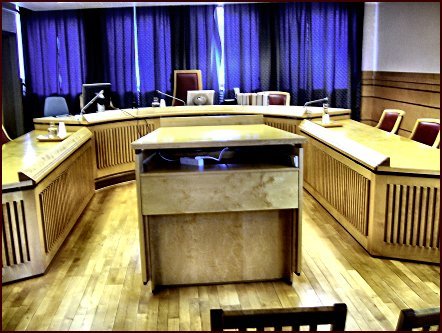
District Court courtroom in Trondheim
There are chairs in the front (no elevated bench) for three jurists. A professional judge, trained in law, is in the center and, in conformity with wide practice in Europe, there are two lay side judges.
There was no problem with taking the picture. Had the court been in session, the staff member told us, we still could have snapped a shot, just so the parties or witnesses weren’t photographed.
As to the jurors...there are none in the District Court, a court of first instance, she advised. We were surprised to learn from her that juries do exist in the Court of Appeal.
A look at the official Norwegian website reveals that where a person is convicted of an offense carrying a prison term of six years or more, “the question of guilt shall be decided by a jury (lagrett)” which “consists of ten persons, if feasible five women and five men.”
It’s essentially a trial de novo, afforded where the defendant, convicted of a serious crime, contests the finding of guilt. Professional judges adjudicate claims of legal or procedural error, including boners in sentencing.
Names of 14 prospective jurors are chosen at random from a register of upstanding citizens—no riffraff on Norwegian juries!—and each side has two peremptory challenges. To the extent they aren’t exhausted, persons are eliminated from the venire by a drawing.
It takes seven of the 10 votes for a conviction—and if that occurs, the foreperson and three jurors, picked by lot, participate with three professional judges and four lay judges in determining the sentence.
Serving as a side judge is akin to jury duty; if called, the citizen must serve.
There are six courts of appeal in Norway, one of which sits in that Trondheim courthouse. These courts “of second instance” hear both civil and criminal appeals. There are no juries in civil cases.
The court attaché who acted as our guide told us there is a movement in Norway to abolish the jury system, but that there’s no thought of dispensing with side judges. I would think it be the other way around; juries have utility; it would not seem that the same could be said for the usually silent “side judges” of the world.
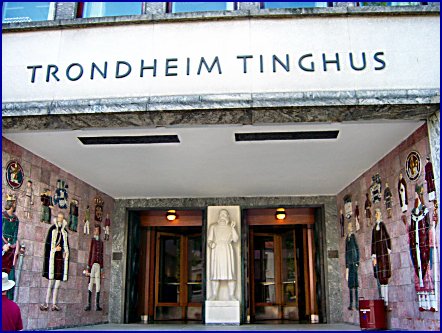
Entrance to Trondheim Courthouse

DAVIS HAS PROPOSALS—Loeb and Loeb attorney Gray Davis, California’s ousted governor, was in good form Friday—animated, but relaxed, articulate and glib—as he set forth proposals before the Rotary Club in downtown Los Angeles at its weekly lunch. He derided unrestrained spending…ironically sounding much like advocates of his 2003 recall who charged that Davis was recklessly overspending taxpayers’ funds.
After the results of the special election were in, and Davis conceded, he boasted of all the worthwhile programs he had launched. He still hadn’t gotten the message that what voters were upset about, in large part, was the folly of spending money the state didn’t have.
It has finally sunk in. Sounding much like someone who wants to get back in favor with voters—that is, who intends to run for office again—Davis told the Rotarians that “just as when we go to a restaurant, and look at a menu” and see an array of desirable choices but settle on “just or two good things to eat,” government must be selective. He said:
“[S]omehow we want government to choose everything on the menu—which is not possible. We need a little discipline. We need to make choices.”
Davis charged that legislators of both parties “want to get something done with their name on it” and, the former assemblyman asserted, “they don’t feel any responsibility for the fiscal well-being of the state.”
He continued:
“People don’t like to hear ‘no.’ No one likes to say ‘no.’ But if you don’t ever say ‘no,’ you end up in the mess that we’re in now.”
His “prescription,” which he said he is “confident will get the State of California back on the right track,” is to limit spending to essentials and, in prosperous times, put excess state monies “in a rainy day fund that cannot be used until the next time there is an economic recession—which is going to happen.”
California, Davis noted, is one of only three states that requires a two-thirds vote to pass a budget. The requirement went into effect in 1933, he recited, saying that nobody remembers why. This doesn’t result in lower spending, but “just the opposite,” he maintained, explaining:
“To get the two-thirds vote, you have to accommodate more interests.”
Joseph Graham “Gray” Davis was elected governor in 1998. That was the first year in which California had an “open primary” and 2000 was the last. The U.S. Supreme Court invalidated the system later in 2000. Last Friday, Davis called for reinstitution of the open primary—in a different form—through voter approval in June, 2010 of SCA 4 which passed the Legislature on Feb. 19.
If voters enact the proposed constitutional amendment, he forecast, “you’ll get pragmatic, thoughtful people, as opposed to ideologues” in office, and those people, Davis said, will be “problem-solvers.”
What you would get would be a bevy of “mugwumps”—with their mugs on one side of the fence and their wumps on the other—rather than anyone who had won approval by a political party. Unlike the system disapproved by the U.S. Supreme Court under which Democrats could vote in the Republican primary, Republicans could vote in the Democratic primary…denying the parties’ respective rights to freedom of association…there would be no party nominations for state posts. Under the proposed “Top Two Candidates Open Primary Act,” two Democrats or two Republicans could be in the same run-off (or, theoretically, a members of a minority party could be in the November fray).
Institution of nonpartisan elections at city, county, and other local levels was an early-1900s reform, and one with merit. The saying is that there’s no Republican way or Democratic way of paving a street. While that’s not entirely true, nonpartisan elections do seem well-suited for local levels—and there’s surely a compelling cause for keeping judicial elections divorced from partisan politics as opposed to judges being beholden to party platforms.
But rendering state and congressional elections essentially nonpartisan, as SCA 4 would do, would cripple the state’s political parties, diminishing drastically California’s influence over national political affairs. It would impair the federal two-party system, impacting as it would congressional elections. And in deflecting attention from parties (candidates could state their parties on the ballot or not), it would put the emphasis on candidates’ personalities rather than the principles to which they adhere. Indeed, party platforms would become irrelevancies.
Among those attending the Rotary lunch was member Steve Cooley, L.A.’s district attorney.
Davis made note of the Republican’s presence and related that when he was governor, he phoned Cooley to tell him that although they were of different parties, his input on applicants for judicial appointments would be prized.
He got the input, the former governor related, and whenever Cooley felt really strongly that someone should be appointed, the appointment was made. (Cooley now heads the local judicial appointments screening committee for Gov. Arnold Schwarzenegger.)
Davis said that Democrats and Republicans alike have lauded his judicial appointments—which is true. His judicial appointments secretary, Burt Pines (now a Los Angeles Superior Court judge) is thought to be chiefly responsible for that.
Aside from urging passage of SCA 4, Davis made sense. Much of what this newborn fiscal conservative said sounded like what former Gov. George Deukmejian has long been saying—and still is.
DEUKMEJIAN
RETAINS VIGOR—“Duke”
recently addressed a national meeting of the Armenian Bar Assn. At 80 (he’s
since had another birthday), he was still vibrant. He told jokes, and they came
off well. He  spoke of governmental matters, and none could mistake that here
was a man of conviction, a statesman.
spoke of governmental matters, and none could mistake that here
was a man of conviction, a statesman.
Deukmejian noted that when he assumed office as governor in January, 1983, the state unemployment rate was 11 percent, about where it is now. The former governor remarked:
“This whole fiscal situation that we’re faced with is very troubling for me. Having been there, having known what it takes, it’s very troubling. You know, it’s really very simple, too. We shouldn’t spend what we don’t have.”
Attendees clapped loudly, the applause was long.
“We need budgets that are based on reality of what is available to spend—not on the wishful dreams of what all the special interest groups want to spend,” the former governor counseled.
“You can’t have jobs unless you have a strong economy—and you won’t have a strong economy if you have an anti-business climate.”
The state and federal budget processes, he asserted, are “in need of some significant repair—and most importantly, a major dose of political discipline.”
He said more, and said much—and it made sense.
Armenian dinners traditionally are lengthy. Both hands on the clock were approaching upright positions. Our aforementioned county prosecutor had already departed.
“Ladies and gentlemen, it’s getting late,” Deukmejian said near the end of his talk. “By the way,” he added, “this is not the record for me.”
He told of the time when as a state legislator, he went to an Armenian dinner in San Francisco. Deukmejian recounted:
“By the time I got up to speak, it was 2 o’clock in the morning....So, we’re doing just fine.”
Armed with her camera at the event was our staff photographer, Cate Norian (daughter of former State Bar Court Judge Kenneth Norian). The dinner took place Saturday, May 9. Cate also took pictures at the May 14 annual meeting of the Half-Norwegian (on the Mother’s Side) American Bar Assn.
Cooley was the speaker at that dinner. In ticking off names of local ethnic bar associations, he paused at mention of the Armenian Bar Assn. to note having attended the dinner on Saturday, querying if it were still going on.
Spotting Cate, who was snapping his picture, he called out:
“Young lady. The photographer lady. Were you there?
“I did happen to be there,” she responded, quipping: “I just got back, and came right here.”
Deukmejian began his talk with three jokes centering on a character in mid-eastern fables, Hoja. I learned something about the stories Cate hadn’t known. The person who had told them to Deukmejian, years back, was Cate’s maternal grandfather.
Copyright 2009, Metropolitan News Company